Suction Levels, Battery Backup and Noise: Reading a Breast Pump Spec Sheet
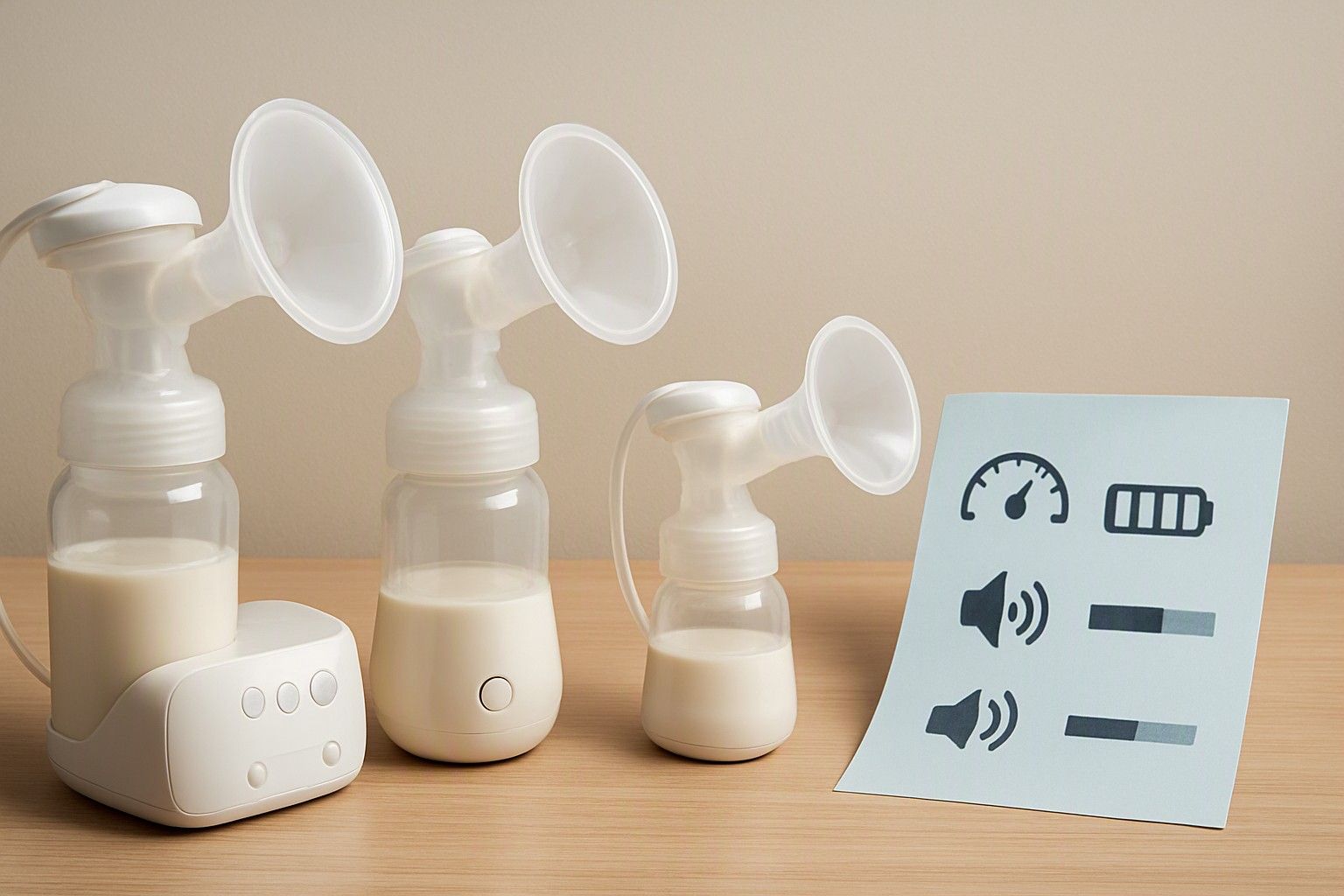
If you are comparing electric breast pumps and the spec sheets all look like a wall of numbers, this article is for you. It explains which suction, mode, battery and noise details actually affect comfort and milk output, and which are marketing. By the end you will know what to look for in an electric pump and what you can safely ignore.
Suction Strength in mmHg: Why Higher Isn't Automatically Better
Suction is measured in mmHg (millimetres of mercury), a unit of pressure. Spec sheets usually quote the maximum a pump can reach, and that single peak figure is the easiest number to advertise. It is also the least useful one for your decision.
Milk output depends on how well the pump imitates a baby's rhythm, how comfortably the flange fits, and whether you are relaxed enough for let-down. Pushing suction higher than you need does not draw out more milk. It can cause soreness, nipple damage and a drop in output, because pain itself can interrupt let-down. Most mothers settle on a level that is strong but never painful, and that level is often well below the pump's ceiling.
So read the range, not the peak. A pump with a low minimum, a sensible maximum and many fine steps in between gives you room to find your own comfort point. A pump with a very high ceiling but only three coarse steps does not. Also remember that makers do not measure mmHg in one standard way, so treat the number as a rough comparison within a similar class of pumps. If milk is slow, check flange size and positioning before turning the suction up.
Massage and Expression Modes and Adjustable Levels
A good electric pump copies the two phases of a feed. The massage (or stimulation) mode uses quick, light pulls to trigger let-down. The expression mode switches to slower, deeper pulls once the milk starts flowing. A pump with only a single fixed pattern forces you to use the same rhythm throughout, and many mothers find that less comfortable and less productive.
What matters is how much control you get. Check whether the pump lets you move from massage to expression manually, so you can switch the moment milk flows instead of waiting for a fixed timer. Check whether speed (how fast the cycles run) and suction (how hard each pull is) can be adjusted separately. Pumps that tie both together in one dial give you less room to tune the experience.
Do not be impressed by level counts alone. Nine levels with tiny steps are more useful than nine levels where each jump feels dramatic. Look for a spec sheet that states how many levels exist in each mode and whether they are shown as numbers, bars or actual mmHg values. If a listing does not explain this, treat it as a gap in the information, not a feature.
Rechargeable vs Plug-In: Planning Around Power Cuts and Inverter Use
Power supply is where Indian buying conditions differ most from the spec sheet's assumptions. A plug-in only pump is fine at a desk with steady mains, but it stops when the power goes, which can happen mid-session at the worst moment. A pump with a built-in rechargeable battery keeps going, and one that also charges through USB can be topped up from a power bank or an inverter-backed socket.
If your home runs an inverter, a plug-in pump will usually keep working on it, but confirm the adapter is rated for the output and fits your sockets. Do not assume a battery pump removes the need for planning either. Charge it at night so it is ready for the first morning session.
Battery capacity (mAh) on its own tells you very little, because the motor draws more power at higher suction. What you want is a stated runtime in terms of pumping sessions, ideally at a medium setting, and a note about charge time. For mothers who pump at work, this matters even more; the details of battery runtime for pumping during a workday away from home are worth reading before you finalise. For night pumping at home, a smaller battery is often enough as long as you charge it daily.
Noise Levels for Night Pumping in Shared Rooms
Noise rarely appears on a spec sheet in a useful way, yet it decides whether you can pump at 3 a.m. without waking the baby, a partner or elders sleeping in the same room, which is common in Indian homes. Where a decibel figure is given, ask under what conditions it was measured. Many claims are taken at the lowest setting with no milk load, so the sound in real use is usually higher.
A few practical checks help. Look for descriptions that mention a quiet motor in the product details, and read buyer feedback specifically on sound rather than overall ratings. Double pumping runs two sides at once and generally sounds louder than a single pump. The tubing and the surface the motor rests on also add rattle, so a pump placed on a folded towel or cushion is noticeably quieter than one on a hard table.
You can also reduce noise through habit. Use the lowest suction level that still empties comfortably, and start the session in massage mode, which tends to be a gentler sound. If a pump has a return window, test it in your actual room at night before you rely on it.
Materials and Seals: BPA-Free Parts and Backflow Barriers
Anything that touches milk should be made of food-grade, BPA-free plastic or silicone. Check that the claim covers all the milk-contact parts, meaning the flange, valves, connectors and bottles, not just the bottle. Also look for guidance on sterilising: the manual should say whether parts can be boiled or steam sterilised and what heat they tolerate. Parts that warp after a few cycles are a hidden running cost.
Silicone valves and membranes are small parts that wear out, so see whether replacements are sold separately and are easy to get in India. A cheap pump with no spare parts becomes a problem within a few months of regular use.
The seal inside the pump matters just as much. A backflow barrier is a diaphragm or sealed layer that stops milk and moisture from travelling into the tubing and motor. Without one, milk can reach the motor, which is hard to clean and can grow mould. If you want to understand how backflow barriers keep milk out of the motor, including why this also matters if you are considering a second-hand pump, that guide goes through the detail. On a spec sheet, look for the words closed system or backflow protection, and for an explanation of how it works.
Displays, Memory Settings and App Features Worth Paying For
Not every extra deserves your money. A simple display that shows the mode, suction level and a session timer is genuinely useful, especially if it has a backlight for night use, because you can adjust without guesswork. It also lets you note the settings that worked for you.
Memory settings are the next most practical feature. A pump that remembers your last level and mode saves you from re-adjusting every session, which matters when you are tired or pumping in a hurry. Check that it remembers both mode and level, not just one.
App connectivity is the one to be most careful about. Session logs, volume tracking and reminders can help if you are building up supply, tracking output for a paediatrician, or managing a strict return-to-work schedule. But they add a dependency on your phone and on the app working reliably, and many mothers stop opening the app after the first fortnight. If you will not use the data, skip it.
A useful rule is to spend first on suction control, battery and seals, then on the display and memory. Pay for app features only if you will actually look at what they record.
Turning Spec Priorities Into a Shortlist
Start by writing down your three must-haves. For most buyers, these are adjustable suction with a comfortable low end, a power setup that survives outages, and a backflow-protected, BPA-free build. Noise, display, memory and app features come next, in the order that matches your day. A mother pumping at night in a shared room should rank quiet operation higher than someone who pumps in a private office.
Then check the price against what the category typically costs. Electric pumps in this category range from ₹450 to ₹26,000, with an average of ₹2,800. Models in the ₹900 band tend to cover the basics, so check carefully that suction steps, seals and spare parts are not missing. The ₹3,000 range is where many buyers look for a balance of adjustable modes and rechargeable power. The ₹8,000 range is where displays, memory and quieter operation are more likely to be on the list. Match your must-haves to the tier that covers them and decide on that basis, rather than stretching for features you will not use.
For the next step, combining spec priorities with fit, hygiene and price in the main buying guide will help you cross-check your shortlist before you buy.
You now have a working checklist for reading any electric breast pump spec sheet: look at the suction range rather than the peak, check for independent massage and expression modes, ask how long the battery lasts in real sessions, question how noise was measured, and confirm the materials and backflow protection. With those answers you can compare models directly and pick one you will actually be comfortable using.

Comments
Be the first to comment.