Keypad, Fingerprint or Key Override: Which Digital Safe Lock Should You Trust?
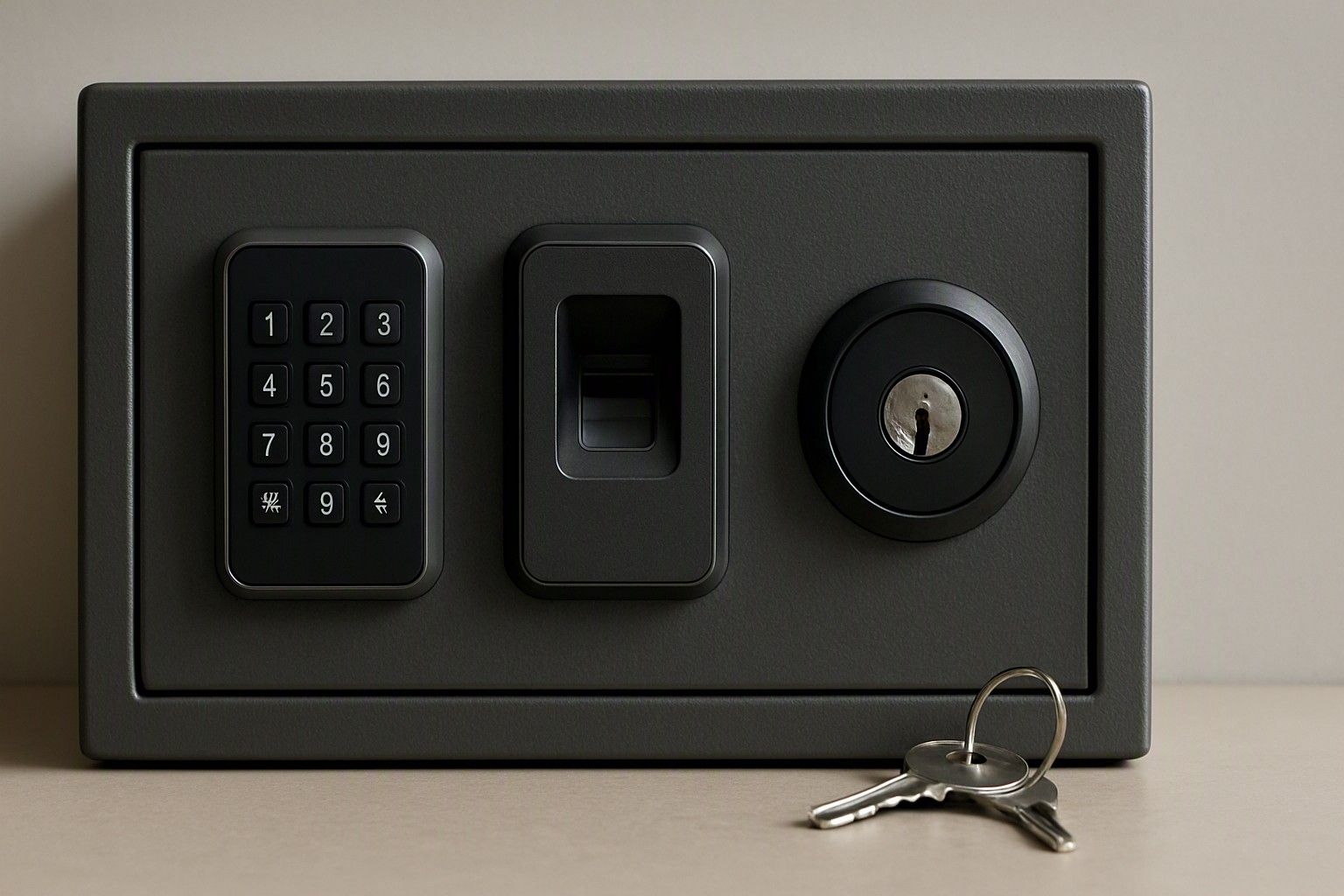
For most Indian homes, a fingerprint safe is not automatically better than a keypad PIN safe. A keypad is the more dependable daily performer, because it doesn't care about humid fingers, kitchen oil or age-worn skin. A fingerprint reader is faster and can't be watched over a shoulder, but only if every user's finger reads reliably. This article helps you decide which suits your household, and why a mechanical key override should be on either choice.
How Motorised and Solenoid Locking Bolts Differ
Before comparing keypad and fingerprint, it helps to know that both are only the front end. Behind them, the safe either releases its bolts with a solenoid or drives them with a small motor, and this affects how the safe feels in daily use.
A solenoid uses an electromagnet to pull back a pin or latch. It is quick and quiet, has few moving parts, and uses very little battery per opening. The door is usually released and you pull or turn a handle to open it. The bolts are often simpler and lighter, which suits smaller home safes.
A motorised mechanism uses a motor to slide the bolts in and out. It is slower and you hear a distinct whirr, and it draws more battery on each operation. It generally pairs with heavier, more visible bolts, which suits larger safes. Its weak spot is that a motor can struggle or stall if the door is pressed against the bolts when you try to open it.
Neither is automatically more secure. What matters is how thick and well-seated the bolts are, which the buying guide covers in more depth. The point for this comparison is that keypad and fingerprint can sit on top of either mechanism, so choose the way you unlock the safe separately from the way it bolts.
PIN Keypad Safes: Reliability, Code Length and Shoulder-Surfing Risk
A keypad is the simplest electronic input, and that simplicity is its main strength. There is no sensor to misread you, so it works with wet hands, cut fingers, mehendi, turmeric-stained fingertips or a sweaty monsoon afternoon. If you press the right digits, it opens.
Its weakness is the human choosing the code. Many people default to a four-digit date of birth, anniversary, house number or the end of a phone number, and these are the first things anyone close to you would try. Choose a longer code that has no link to your life, and avoid repeating or sequential digits.
Shoulder-surfing is the other risk, and in a joint family, where people constantly walk in and out of rooms, it is real. Open the safe when the room is empty. Wipe the keypad now and then, because oily smudges over a few frequently used keys give away the digits. Some models let you press extra random digits before or after the real code. Check this on the specific model rather than assuming it.
Finally, look at how the safe handles repeated wrong entries. A temporary lockout after a few wrong attempts is a useful protection against someone trying codes while you are away.
Fingerprint Safes: Sensor Quality, Sweaty Hands and Elderly Users
Fingerprint access is attractive because there is nothing to remember and nothing for an onlooker to copy. In practice, it depends heavily on the sensor. Sensor quality varies widely across the price range, and weaker modules reject genuine fingers more often, which becomes frustrating within weeks.
Indian conditions test these sensors. Humid coastal summers, sweaty palms after a commute, oil and masala on a cook's fingers, and the dust on a tradesperson's hands can all cause misreads. A wet or very dry finger often fails even on a decent sensor.
Elderly users are the group most often let down. Ridges wear with age and years of manual work, skin gets dry, and a slight tremor makes it harder to place the finger in the same spot. If your parents or grandparents will use the safe, test it with them before you commit, and do not rely on the showroom demonstration alone.
If you go this route, enrol the same finger several times at slightly different angles, and enrol more than one finger per person. Most importantly, buy a safe that also accepts a PIN and has a key override. A fingerprint-only safe leaves you with no fallback on the day the sensor fails.
Emergency Mechanical Keys: Useful Backup or Weak Point?
Every digital safe depends on electronics and batteries, and either can fail. A mechanical override key is the only way in when that happens, so it is a genuine safety net, not a gimmick. If you are weighing a keyless design, remember that losing power or a faulty circuit could lock you out of your own documents and jewellery.
The same key can also be the weak point. A keyhole, even a hidden one behind a cover, tells a burglar there is a manual way in, and a cheap cylinder is easier to attack than the electronic lock. Your protection against this is how you treat the key.
Keep it away from the safe and away from the bedroom almirah where the safe sits. Don't tape it behind the unit or leave it in a nearby drawer. A bank locker or a trusted relative's home is a sensible place, and keep a spare there too. Don't have copies cut casually at a roadside shop, because every duplicate is another way in.
For the practical side, see what to do when batteries die and the keypad goes blank. The short version is that the key is there for that moment, so know where it is before you need it.
Dual Authentication and Multiple User Codes for Joint Families
In a joint family, the question is rarely just how to unlock the safe. It is who can unlock it, and whether one person should be able to do so alone.
Multiple user codes or fingerprints give each trusted member their own credential. That means you can remove one person's access without changing everyone else's, which is far cleaner than sharing a single code that the whole house knows. Check how many users a model supports, because the limit varies, and whether there is a separate master or admin code that manages the others.
Dual authentication requires two credentials, such as two different codes, or a code plus a fingerprint, before the safe opens. This suits shared valuables, such as inherited jewellery, property papers or business cash, where you want two people to agree before anything is taken out.
The trade-off is convenience in an emergency. If one of the two people is travelling, unwell or has forgotten their credential, nobody gets in without the key override. Keep the admin code written down and stored away from the safe, and review the list of active users after any family dispute, a move, or a long-term guest leaving. Dual authentication also depends on the safe offering it, so confirm that before buying.
Which Lock Type Fits Which Household
Here is how the options match the situations Indian buyers most often describe.
- Elderly parents using the safe regularly: a keypad with large, clearly marked keys and a key override. Fingerprint reading is the least predictable for ageing skin.
- Working couple with school-age children: a fingerprint safe that also accepts a PIN is convenient, and you can enrol only the adults. The PIN covers wet or dirty hands.
- Joint family with several adults: multiple user codes, ideally with dual authentication for the shared valuables. Keypad plus fingerprint combinations work well here.
- Humid coastal home, or a home where cooking happens near the safe: lean towards keypad, because fingerprint sensors face more misreads.
- Rented flat, rarely opened safe: a keypad with a key override. Choose a simple, dependable lock that doesn't depend on a sensor.
Prices across this category run from ₹5,000 to ₹60,000, with an average around ₹12,000. Don't stretch your budget just to get fingerprint access. If a fingerprint model fits your tier, whether ₹7,000, ₹15,000 or ₹35,000, insist on a PIN fallback and a key override. A keypad model with a sound body and bolts is a stronger purchase than a fingerprint model that cuts corners elsewhere. You can match the lock mechanism with steel, size and bolting choices in the main guide before you settle on a model.
So, is a fingerprint safe better than a keypad PIN safe for home use? Not by default. A keypad is the steadier everyday choice, and fingerprint is a convenience that works when your fingers and the sensor cooperate. Whichever you pick, make sure there is a second way in, either a PIN alongside the fingerprint or a mechanical key kept safely away from the safe. With that fallback in place, you can decide today with confidence.

Comments
Be the first to comment.