How Many Litres Do You Need? Sizing a Digital Safe for Jewellery, Cash and Documents
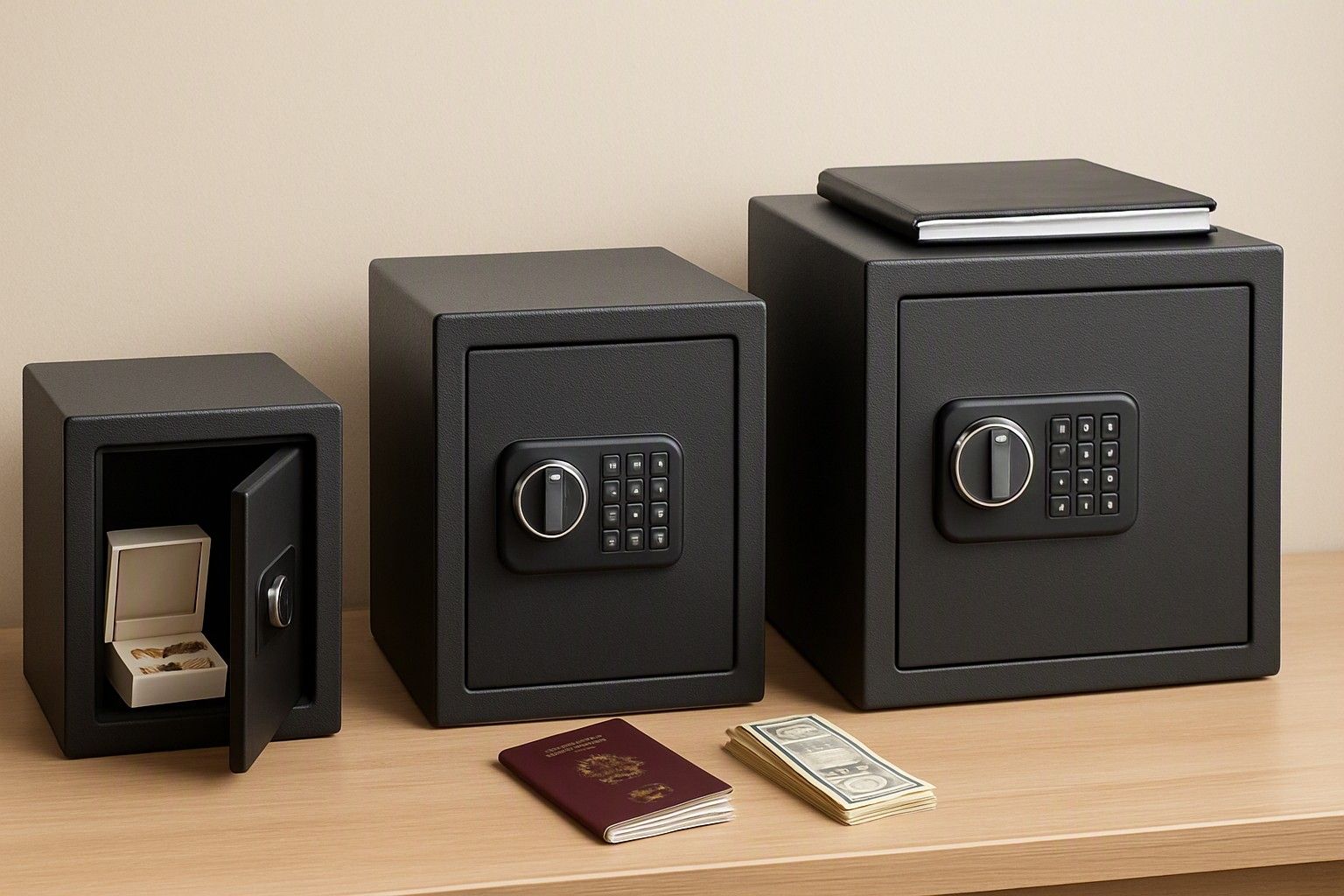
If you are trying to work out what size digital safe will hold your jewellery and property papers at home, this article is for you. A litre figure on a listing tells you very little until you set it against real things: a necklace box, an A4 file, a laptop, a bundle of notes. Below, we translate litres into items so you can pick a size with confidence.
Litre Capacity vs Usable Internal Space
A safe's litre figure is the volume of its internal cavity, and you rarely get to use all of it. Carpet lining, a fixed or removable shelf, and the bulge of the lock mechanism and battery box on the inside of the door all take space. A shape that is deep but narrow can also hold fewer real objects than the number suggests.
So do one calculation yourself. Find the internal height, width and depth in centimetres on the listing, multiply the three, and divide by 1,000. A cavity of 30 × 40 × 30 cm, for example, works out to 36 litres. If the listing gives only external dimensions, be careful: steel walls and the door can easily take several centimetres off each side.
The dimensions matter more than the litres. Ten litres of tall, narrow space will not take a flat jewellery box, while ten litres of wide, shallow space will not take a standing file. Compare the internal measurements with the biggest item you plan to store, then use the litre figure only as a rough cross-check. Allow roughly a centimetre on each side for lining.
Compact, Mid-Size and Large Safes: What Actually Fits Inside
There is no official size standard, so treat these as rough working bands and check the internal dimensions on each listing.
Compact (roughly under 20 litres): This size suits passports, a few small jewellery pouches or one or two boxes, a cheque book, and folded documents. Flat A4 papers fit only if the internal width is about 22 cm or more. It works for a small, tightly chosen set of valuables, not for a household's full paperwork.
Mid-size (roughly 20 to 40 litres): Most families will find this the most useful band. It generally takes several jewellery boxes, a stack of A4 files, passports for the household, and some cash. A slim laptop may fit flat, depending on the depth. Having a shelf here lets you separate papers from jewellery.
Large (above 40 litres): This size is for a laptop or two, full property files standing upright, multiple jewellery boxes, and room left over. The trade-off is that it needs more wall or wardrobe space and costs more. If you do not have the valuables to fill it, you are paying for emptiness.
Storing Jewellery Boxes, Gold Coins and Property Papers
Start with jewellery, because the box is usually bigger than the piece. Necklace-set boxes commonly run about 25 to 30 cm long and 15 to 20 cm wide, and bangle boxes are taller. Measure your actual boxes. If you are happy to move pieces into soft pouches, you can fit far more into a smaller safe, but boxes protect delicate settings from scratching.
Gold coins and small bars are the easy part. They are compact and dense, so they take almost no volume, though they do add weight to a shelf. A small tray or pouch is enough.
Property papers are where buyers most often get caught. Sale deeds, registry copies and loan documents often arrive in legal-size folders or are folded into bulky bundles. Check whether your files are A4 or longer than about 30 cm, and whether you want them flat or standing. A safe that fits your folders without folding them keeps the paper from creasing at the edges. If originals are heavy, consider storing only the originals in the safe and keeping photocopies elsewhere.
Room for a Laptop, Passports and Cash Bundles
A laptop is the item that most often forces a size jump. A 13 to 15 inch laptop is roughly 30 to 36 cm wide and a few centimetres thick, so you need an internal width and depth above that, with a little spare for the lining. Many compact safes simply cannot take one lying flat. If a laptop matters to you, make it the first item you check against the listing.
Passports are small, at about 12.5 × 8.8 cm, so a household of four takes very little space. They fit in almost any safe, and even a small internal tray will do.
Cash takes less room than people expect. A ₹500 note measures about 15 × 6.6 cm, and a bundle of 100 notes is roughly a centimetre thick. A few bundles fit easily on a mid-size safe's shelf. If you keep cash for emergencies or festival and wedding expenses, plan on a handful of bundles, not a stack.
Add up what you carry in each category, then add the laptop's footprint, and you will see why most homes land in the mid-size band.
Weight vs Size: Why Heavier Safes Resist Removal
A safe that one person can lift is a safe that a thief can carry out of the house and open at leisure. This is the less obvious cost of choosing compact. Smaller safes are easier to hide in a wardrobe, but they are also easier to take away, so what keeps them in place matters as much as the lock.
Weight comes mainly from steel thickness and body construction, not from litres alone. A large safe with thin walls can weigh less than a small, solid one, so read the listed weight alongside the capacity. A heavier safe is harder to pry or move, and it makes a casual theft much more difficult.
If you prefer a smaller safe, the answer is not to avoid it but to anchor it. Our guide on bolting a compact safe so it can't be carried off covers wall, floor and wardrobe fixing in detail. As a rule, check that a compact model has pre-drilled bolt holes in the body before you buy, since a safe you cannot fix down relies on being hidden, not secure.
Shelves, Carpet Lining and Internal Compartments
Internal layout changes how much you can actually use. A removable shelf is the most valuable feature for mixed contents. With it in place, you can keep papers on the bottom and jewellery boxes on the top. Without it, you can stand tall files upright in the same space. A fixed shelf is less flexible, so check its height against your tallest item.
Carpet or soft lining protects jewellery and watches from scratches and stops items from rattling. It also takes a little space on every side, which is why the usable volume is always lower than the stated litres. For gold and silver, a lined interior is worth having. For documents alone, it matters less.
Small internal compartments or a top tray are useful for passports, coins, keys and pen drives, because they stop small things from sinking beneath large ones. If your jewellery is in many small pieces, a tray keeps it from tangling.
In humid Indian monsoons, you may also want to place a few silica gel sachets inside, especially for papers and silver, which tarnishes.
Leaving Room for What You Will Store Later
The safe you need today is rarely the safe you need in three years. Jewellery gets added at weddings and festivals, property files multiply with each purchase or loan, and children's documents join the pile. A reasonable rule is to buy a size that leaves roughly a quarter to a third of the space empty on day one.
There is also a cost logic. Across this category, cost of digital safe locker run from ₹5,000 to ₹60,000, with an average around ₹12,000. Moving up a size usually costs more, but buying one safe that fits your needs for years is generally cheaper than replacing a too-small one. Within the ₹15,000 tier, for instance, you will find a range of sizes to compare, and ₹35,000 opens up larger bodies and more features.
Size is only one check. Once you have a litre range in mind, weigh capacity against the other checks for an Indian home safe, such as lock type, build, and power backup, before you decide.
You now have a way to turn litres into things: measure your biggest box, file and laptop, check the internal dimensions, and add some spare room. For most homes storing jewellery and property papers, that points to the mid-size band, with compact working only if you keep the contents small and bolt the safe down.

Comments
Be the first to comment.