Upright, Recumbent, Spin Bike or Air Bike: Which Frame Style Fits Your Workout?
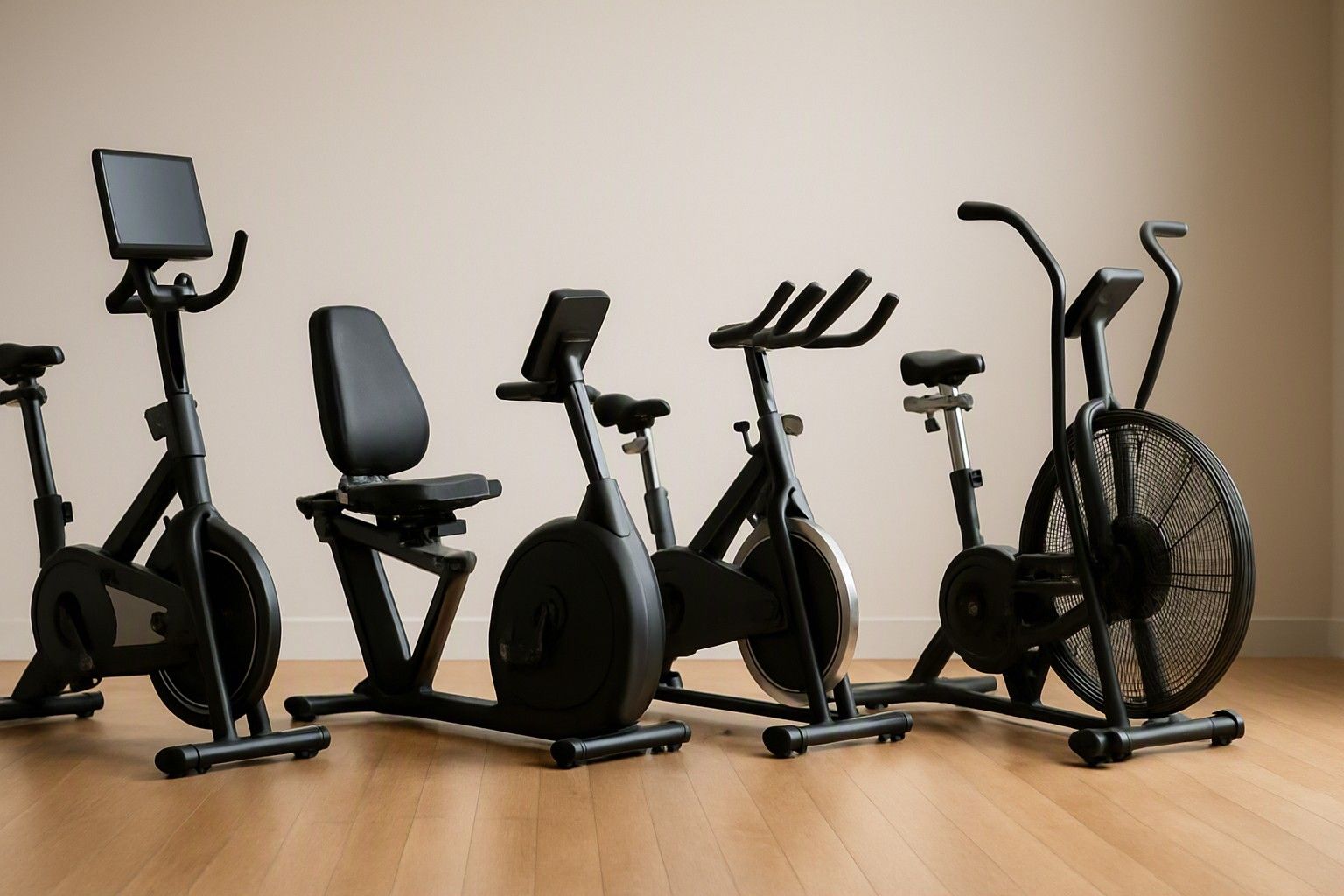
If you are choosing between an upright, recumbent, spin or air bike, the short answer is this: an upright suits most Indian homes and general fitness, a recumbent suits anyone who needs back support or easy mounting, a spin bike suits hard, structured training, and an air bike suits short, brutal full-body intervals. The sections below cover how each frame positions your body, what it asks of your floor space and your neighbours' patience, and which goal it fits.
How Each Frame Style Positions Your Body
The frame decides where your weight sits, and that decides how long you can comfortably ride.
On an upright bike, you sit fairly tall with a slight forward lean. Your weight rests on the saddle with some support from your hands, and the pedals sit below you, much like a regular bicycle.
A recumbent bike seats you in a reclined, chair-like position with a backrest. The pedals sit out in front of you, so your back and hips are supported and little weight goes through your wrists or hands.
A spin bike puts you in a racing-style posture, leaning forward over the handlebars. Your weight is shared between saddle, hands and pedals, and the frame allows you to stand and climb out of the saddle.
An air bike keeps you upright, but its handlebars move back and forth with your pedalling. Your arms work alongside your legs, so the whole body is involved on every stroke.
These positions explain most of the trade-offs that follow: comfort, intensity, joint load and how much the bike demands from you.
Upright Bikes: Compact All-Rounders for Most Homes
An upright bike is the default choice for a reason: it takes the least floor space of the four, and the posture feels familiar. Many models fit into a bedroom corner or beside a sofa, and some fold or have transport wheels, which helps in flats where the bike must be moved aside after each session.
The seat height is adjustable, so one bike can usually serve several family members. Resistance is commonly magnetic and fairly quiet, which suits early-morning or late-evening rides in an apartment building. Sessions of twenty to forty-five minutes at a steady pace are what an upright handles best.
The trade-offs are real, though. Because your weight sits on the saddle, long rides can leave you sore, especially on a narrow seat. Your lower back also carries more load than on a recumbent, so anyone with chronic back pain should be cautious. And an upright generally offers a gentler, less punishing ride than a spin bike, so very fit riders may outgrow it.
If you want a bike for regular cardio, weight management or a mixed household, an upright is the safest place to start.
Recumbent Bikes: Back Support and Easy Mounting
The recumbent's big advantages are the backrest and the seat. The wide, cushioned seat spreads your weight, the backrest supports your spine, and the low seat height makes getting on and off simple. Models with a step-through frame need no leg swing at all. This matters for riders with back pain, arthritis, balance concerns or who are recovering from an injury, because pressure on the lower back, wrists and knees stays low.
For a parent or grandparent who will be the main rider, read about choosing a step-through recumbent for elderly riders before you shortlist, since seat height, pedal reach and stability need closer attention in that case.
The costs are space and intensity. A recumbent has a longer footprint than an upright and is usually heavier, so measure the spot before you buy. The reclined position also engages your core less and makes very hard efforts awkward, so it suits steady, low-impact riding rather than high-intensity training. If comfort decides whether you will actually ride, though, that is a fair price to pay.
Spin Bikes: Heavy Flywheels for Intense Training
A spin bike is built for effort. It has a heavy flywheel, a fixed drive and a frame that lets you lean forward, stand and climb, so the ride feels closer to road cycling. Seat and handlebars usually adjust in more than one direction, which helps you dial in a position you can hold for long, hard sessions.
The flywheel is what gives the ride its smoothness and carry-through. It is also the spec buyers most often misjudge, and how much flywheel mass a spin bike really needs depends on your body weight and how hard you plan to train.
The downsides are comfort and suitability. The forward posture is demanding on the lower back, wrists and the saddle, and beginners with knee or back problems may find it unforgiving. Many spin bikes have no console beyond a basic display. Noise depends on the drive, with belt-driven bikes generally quieter than chain-driven ones. You also need a firm floor and enough clear space around the bike to stand safely.
Choose a spin bike if you want to train, not just move, and you are comfortable with a sportier posture.
Air Bikes: Unlimited Resistance, Louder Rides
Air bikes work differently from the other three. A large fan provides the resistance, so the harder you push, the harder it pushes back. There is no preset limit, which makes it popular for short interval sessions where you go all out for thirty seconds and rest. The moving handles add an arms-and-legs workout, so calories burn quickly in a short time.
That design brings the compromises. The fan is loud, and the noise rises with effort. In a flat with shared walls, or if someone is sleeping nearby, this may rule it out for early or late workouts. The bike is also big and heavy, and the fan blows air at you, which is welcome in humid weather but not everyone's preference.
Because resistance rises with your own effort, there is no gentle setting you can lock in. It is a tough machine for steady, easy rides, and the moving handles may be uncomfortable if you have shoulder or elbow problems.
An air bike makes sense if you have the space, the tolerance for noise and a taste for hard, short workouts. For anything gentler, one of the other frames will serve you better.
Matching the Frame Style to Your Goal
Start with what you will realistically do three or four times a week, then check it against your space and your body.
- General fitness, weight management, shared household: upright.
- Back pain, knee trouble, older riders, rehab-style riding: recumbent.
- Structured training, endurance, high-intensity classes: spin bike.
- Short, maximum-effort intervals and full-body conditioning: air bike, if noise and space allow.
Price follows the same pattern loosely. Across the category, bikes run from ₹3,500 to ₹50,000, with an average of ₹12,000. Uprights tend to cover the lower and middle brackets, including ₹4,000 and ₹12,000, while sturdier recumbent, spin and air frames tend to push towards ₹30,000. That spread gives you real choices today, so you can decide on the frame that fits your routine without waiting for a better moment.
If two styles still look equally suitable, pick the one you will be most comfortable sitting on for thirty minutes, since the bike you ride often will always outperform the one that is technically superior. Once the frame is settled, our buying guide covers the remaining decisions after settling on a bike style, such as resistance type, console features and budget.
So, which frame should you buy? An upright if you want one dependable bike for a regular routine, a recumbent if comfort and easy mounting come first, a spin bike if you want to train hard, and an air bike only if you can live with the noise and want intense intervals. Match that to your floor space and your body, and the choice becomes much simpler.

Comments
Be the first to comment.