Console or Gaming PC: Which Makes More Sense for an Indian Gamer?
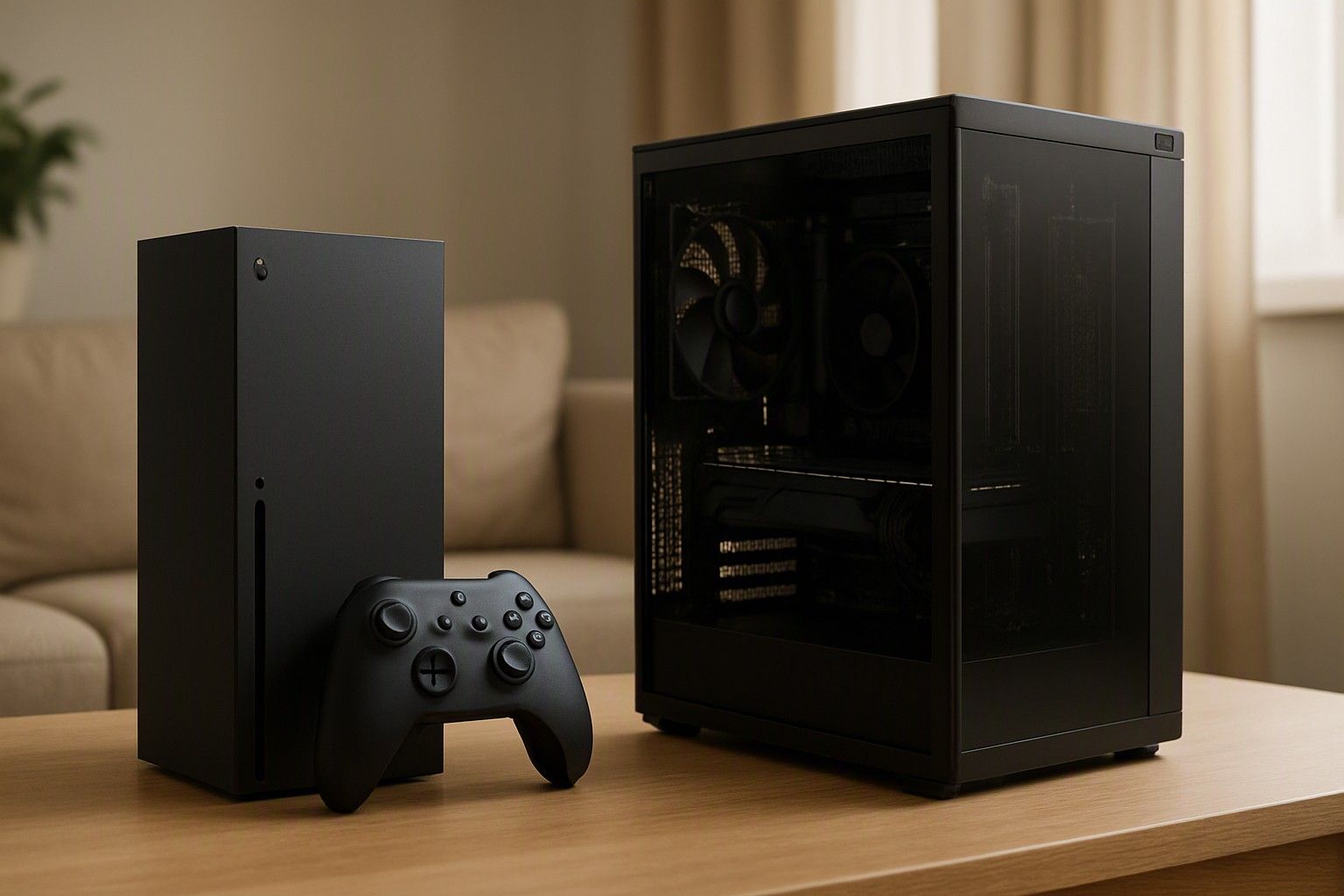
If you have a console-sized budget and cannot decide between a console and a gaming PC, this article is for you. It is written especially for people moving up from mobile gaming who want to know which platform gives more play per rupee in an Indian home. Short version: a console wins on simplicity and value at lower budgets, a PC wins on flexibility, and the sections below show which of those matters more for you.
What ₹40,000 Gets You in a Console vs a PC Build
Consoles in this category run from ₹25,000 to ₹65,000, with an average of ₹40,000. That single price usually covers the hardware, built-in storage and a controller. You still need a television and your first games, but nothing else.
A PC build at the same money is a different calculation. The budget has to cover the processor, graphics card, memory, storage, power supply, cabinet and operating system licence. Then you need a monitor, keyboard, mouse and headset, unless you already own them. In practice, the money spent on peripherals comes straight out of what could have gone into performance.
The budget tiers show how this plays out:
- ₹28,000: A console is usually the stronger buy. A PC at this level tends to mean entry-level graphics and compromises on settings.
- ₹40,000: The gap narrows. A PC can run many popular titles well, but you will probably still be stretching for peripherals.
- ₹60,000: A PC gives you real headroom and a path to upgrade, if you already own a monitor and accessories. If you don't, a console still delivers more finished experience per rupee.
If you want to start playing now with a predictable total, the console's all-in price is the easier number to commit to.
Game Prices: PC Regional Pricing and Sales vs Console Store Pricing
Hardware is a one-time cost. Games are the part you keep paying for, and the two platforms handle it differently.
PC storefronts commonly offer regional pricing, so many titles are listed at rupee prices lower than the console equivalents. They also run frequent discount events, and older games get cheap quickly. The PC also has a deep catalogue of free-to-play and low-cost indie games, and online multiplayer is generally free.
Console stores tend to hold new-release prices higher and discount less often. Paid online multiplayer is typically required for most online games. On the plus side, physical discs can be lent to a friend or resold, which softens the cost of a single purchase.
PC discounts make a library cheaper over time, but they are not a reason to hold off buying the hardware. What matters is which platform's pricing suits the games you will actually play. If you mostly buy a few big releases a year and play online, the recurring costs on a console matter. You can see how game purchases and subscriptions add up on consoles before you decide. If you like to collect a large backlog of cheap older games, the PC's pricing model suits you better.
Setup, Upgrades and Maintenance Effort
A gaming console is built to be set up in minutes. You connect it to the TV and the power, sign in, install updates and start playing. There are no drivers to manage, no compatibility checks and a single warranty to claim on if something goes wrong. The trade-off is that the hardware is fixed. What you buy is what you have until the next generation arrives.
A PC asks more of you. Someone has to assemble it or you buy a pre-built, and either way you will handle driver updates, operating system updates and the occasional troubleshooting. Components carry separate warranties, so a fault can mean working out which part failed and which seller to approach.
Indian conditions add some practical points. Dust builds up quickly in many homes, and a PC needs regular cleaning to keep temperatures in check through summer. Voltage fluctuations and power cuts make a surge protector or UPS a sensible addition for a PC, which adds to the cost.
The benefit of that effort is upgradability. You can swap the graphics card or add storage later instead of replacing the whole machine. If you enjoy tinkering, that is a feature. If you do not, it is a chore.
Coming From Mobile Gaming: BGMI and Free-to-Play Habits
Many players arrive from mobile battle royales and free-to-play games, where the game costs nothing and spending happens in small amounts on skins and passes. Moving to either platform changes that habit, because premium games ask for a larger sum up front.
A PC is the gentler transition for this kind of player. It has a large library of free-to-play titles, and mouse and keyboard controls feel closer to the fast aim and quick actions you may already be used to. Consoles have free-to-play games too, but the catalogue is smaller and most of what drives people to buy one is paid.
Controllers matter as well. Moving from touch controls to a gamepad takes some adjustment, though most players adapt within a few sessions. A PC lets you use either.
One honest point: if your whole circle plays a mobile-only title, neither a console nor a PC will replace it, and you may be buying for the games your friends are not playing. Decide whether you want to keep playing your mobile favourites alongside a new platform. If so, the price of the extra device should be justified by the premium games you want, not by the games you already play for free.
Living-Room Play vs Desk Play in Indian Homes
Where the machine lives often decides which platform people actually use. In many Indian homes there is one main television, and it is shared with family viewing, cricket and daily routines. A console fits the sofa-and-TV setup, supports easy couch play with siblings or friends, and can be switched off and forgotten without leaving a cluttered desk.
A PC belongs at a desk. It needs a monitor, a chair, space for a cabinet and a spot with good airflow. That works well in a bedroom or study, and it suits solo play for hours. It is less natural for group sessions, though a PC can be connected to a TV with some effort.
The main question is competition for the screen. If the living-room TV is busy in the evenings, a console may not get much use. If the only free space is a corner of your room, a PC and monitor may fit better. Households with one shared television should also look at whether a hybrid suits a home with one shared television, since a handheld-capable option can change this problem.
Platform Exclusives You Cannot Get Elsewhere
Exclusives are often the deciding factor, and they cut in both directions.
Console makers publish their own first-party games, which are built to run on a single piece of hardware. Some of these arrive on PC later, often after a delay, and some never do. If a particular console-only series is what draws you in, no PC build gives you access to it, however powerful it is.
The PC has its own category of things you cannot get on any best gaming console also. Many strategy, simulation and management games are designed around mouse and keyboard and are best, or only, available there. Modding communities extend games for years, and a large share of competitive and esports titles are built for PC first.
The practical approach is to write down the five or six games you most want to play, then check which platforms each one is on. If most are available on both, the decision comes back to cost, space and effort. If most sit on one side, let that settle it. Buying hardware for a game library you do not intend to play is the most common way to pay for the wrong platform.
When a Console Is Clearly the Right Call
A console is the clearer choice in several situations:
- You want to play with minimal setup. You would rather spend an evening playing than choosing parts and fixing drivers.
- Your budget sits near the lower end. At that level a console gives more finished performance than a PC once peripherals are counted.
- You play on a shared television. The sofa and TV are where gaming will happen, often with family or friends.
- The games you want are console-only. First-party titles you care about settle the question without further comparison.
- You prefer a controller. If a gamepad is how you want to play, a console is built around it.
A PC is the better call if you want mouse and keyboard games, plan to upgrade over time, or already own a monitor and peripherals. If the points above describe you, a console is a confident purchase today. Once you settle on one, read through the checks that matter once you settle on a console to pick the right variant and avoid common mistakes.
So, a console or a PC for the same money? For most people moving up from mobile gaming who want to plug in and play on a shared television, a console is the simpler and better-value route. A PC makes sense when you want its game library, its controls and its upgrade path, and you are happy to put in the extra effort and peripherals. Match that to your games, your space and your budget tier, and you have your answer.
Comments
Be the first to comment.