Official vs Imported Consoles in India: Warranty, Service and Seller Red Flags
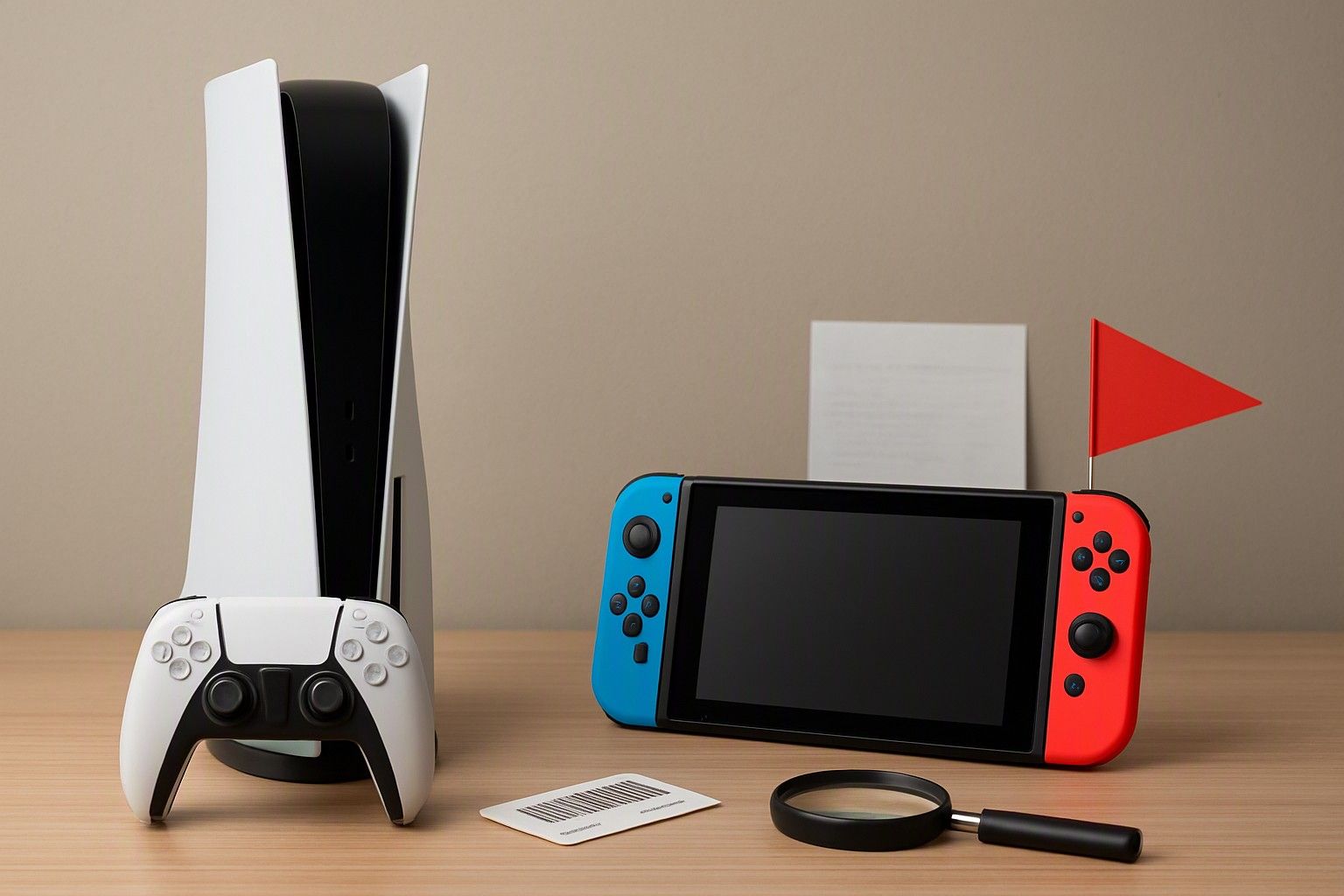
An imported or grey-market PS5 or Switch can work perfectly well on day one, but it is rarely safe in the way an officially distributed unit is. The real risk is what happens later, when you need warranty service, a repair or proof of purchase. If you are about to pay a marketplace seller or local shop for a console, this guide shows how to tell the difference and what to check before you pay.
How to Identify an Officially Distributed Unit
An officially distributed console comes through the brand's authorised channel in India. That means the brand's own listed retailers and the large, established e-commerce sellers the brand names as partners.
The box and paperwork give you the first clues. Look for India-specific labelling: importer or marketer details, a printed maximum retail price, a customer-care contact and an India warranty card or warranty terms. Units brought in from abroad often carry foreign-market labels, no India MRP sticker, or a sticker pasted over the original print.
Two checks go further than the box:
- Check the seller against the brand. The brand's India website usually lists where to buy and where to get service. If a seller claims to be authorised but isn't listed, ask them to show proof.
- Check the serial number with the brand. Contact the brand's India support with the serial number and ask whether the unit is covered by an India warranty. A genuine unit sold through official channels should not make this awkward.
If a seller avoids sharing the serial number before you pay, treat that as a warning in itself.
Warranty Coverage on Imported and Grey-Market Consoles
This is where grey-market units cost you the most. An imported gaming console of popular brand was usually sold under another country's warranty terms. Brand service in India can decline to cover it, or cover it only partly, because the unit was not distributed here.
Many sellers fill the gap with a "shop warranty" or "seller warranty". That promise is only as strong as the seller. It disappears if they close the listing, change their account or simply stop replying. It is also usually limited to replacement or a repair at a third-party workshop. Unauthorised repair work can leave you with a console that official service then refuses to touch.
Consoles are not repair-free devices. Disc drives, HDMI ports, cooling fans and controllers are common failure points. A saving on an import can be wiped out by a single out-of-pocket repair.
When you compare prices, include the cost of being unsupported. If the official unit sits near ₹40,000, a small discount on an imported one rarely justifies giving up India warranty coverage and brand service.
Region, Plug Type and Voltage Differences
Imported units raise practical issues beyond warranty. The first is the power cable. A console shipped for another market may come with a US, UK or EU-style plug. Indian sockets take different pins, so people often use a loose travel adaptor. That fit can be poor and is not something to leave plugged in behind a TV unit for years. The safer route is a proper cable made for the console's own power connector, with an Indian plug.
The second is voltage. India runs on 230V, and many modern consoles have a wide-range internal power supply. Do not assume this, though. Read the rating label on the console, or on its power brick if it has one, and confirm it lists a range that covers Indian mains. A unit that is not rated for it should not be bought at any discount.
The third is the account region. The online store, saved payment options and some content are tied to the region of your account, so check this before assuming an import will behave like a local unit. Whatever the console's origin, protecting the console from Indian voltage swings with a surge-protected socket or stabiliser is worth doing.
Checking Refurbished and Pre-Owned Consoles
Refurbished and pre-owned units can make sense, but only if you can inspect them and the paperwork is clean. Meet the seller, or get an in-person return window, and test the console properly:
- Match the serial number on the console, its box and the system settings screen. Mismatches suggest a swapped or reassembled unit.
- Confirm it is signed out and reset. A console still tied to the previous owner's account can be locked or restricted, and it is difficult to resolve afterwards. Ask whether it has ever been banned from online services.
- Run it for at least 20 to 30 minutes. Listen for loud fan noise and watch for overheating or random shutdowns.
- Test every port and the disc drive with a real game disc. Check HDMI output, USB ports and wireless connectivity.
- Test every controller. Look for stick drift, sticky buttons and charging problems. Drift is a common problem on handheld-style controllers.
Ask what "refurbished" means. A factory-checked unit and a unit repaired in a local workshop with replaced parts are very different products. Insist on the original purchase invoice if any official warranty remains, since coverage rarely passes on without it.
Marketplace Seller Red Flags
Most unsafe deals look attractive at first. These patterns should slow you down:
- A price far below what this category normally costs. Consoles generally sit between ₹25,000 and ₹65,000. A "brand new sealed" unit offered well below ₹25,000 is very likely imported, refurbished, stolen or a scam.
- Listings that say "international version", "import" or "no warranty", or that hide the origin of the unit.
- Stock photos only. A genuine seller can show the actual box, labels and serial number.
- A brand-new seller account with few ratings, or reviews that complain about missing bills, region problems or non-working units.
- Pressure to pay outside the platform, such as direct UPI transfers, to "save on fees" or to "hold the unit".
- No clear return policy, or a refusal to accept returns on a unit that is dead on arrival.
- Vague answers. A seller who cannot say where the unit came from, or avoids a GST invoice, is telling you something.
Pay through the platform so you keep its dispute process. Record an unboxing video when the parcel arrives, showing the sealed box, labels and serial number, in case you need to raise a claim.
Invoice, GST Bill and Serial Number Verification
A proper invoice is your only practical proof that you bought a legitimate unit. Before you pay, confirm that it will show the seller's registered name and address, their GSTIN, the product description, the date, the amount and ideally the console's serial number. It should be issued in your name.
You can verify the GSTIN on the government GST portal's taxpayer search. If the registered business name does not match the seller you are dealing with, or the number does not exist, walk away.
Then match the serial number three ways: the one printed on the invoice, the one on the box and console label, and the one shown in the console's system settings. All three should agree. If they do not, you may have a swapped box or a unit that was never part of the sale.
Be wary of "cash with no bill" offers. Without a valid invoice you cannot easily claim warranty or file a consumer complaint, and you cannot show where the unit came from. Any discount for skipping the bill is borrowed against future repairs.
A Final Seller Checklist Before You Pay
Run through this list before money changes hands:
- The seller is a brand-listed retailer, or a marketplace seller with a long, clean history.
- The box carries India labelling, an MRP and India warranty terms.
- The serial number was shared in advance and checks out with the brand's India support.
- The GST invoice is in your name, with a verifiable GSTIN and the serial number on it.
- The rating label confirms the unit works on Indian mains, and an Indian-plug cable is included.
- The return and replacement policy is written down, and payment goes through the platform.
- For a pre-owned unit, it is signed out, resets cleanly, and passes the disc, port, fan and controller checks.
- The price sits in a realistic range, not far below ₹25,000.
New consoles typically cost between ₹25,000 and ₹65,000, with an average of ₹40,000. A verified official unit at a normal price is a confident purchase today, because you are paying for warranty and service as well as the hardware. If you are still choosing a model or budget, go back to the broader pre-purchase considerations for a console in India before you commit.
So, is it safe to buy an imported or grey-market PS5 or Switch in India? Safer than a blind bet, but riskier than an official unit, mainly because warranty and service are where imports tend to fail. If you cannot verify the seller, the invoice and the serial number, the saving is not worth it. If you can verify all three, you can buy with confidence.
Comments
Be the first to comment.