Geyser Power Rating and Running Cost Explained
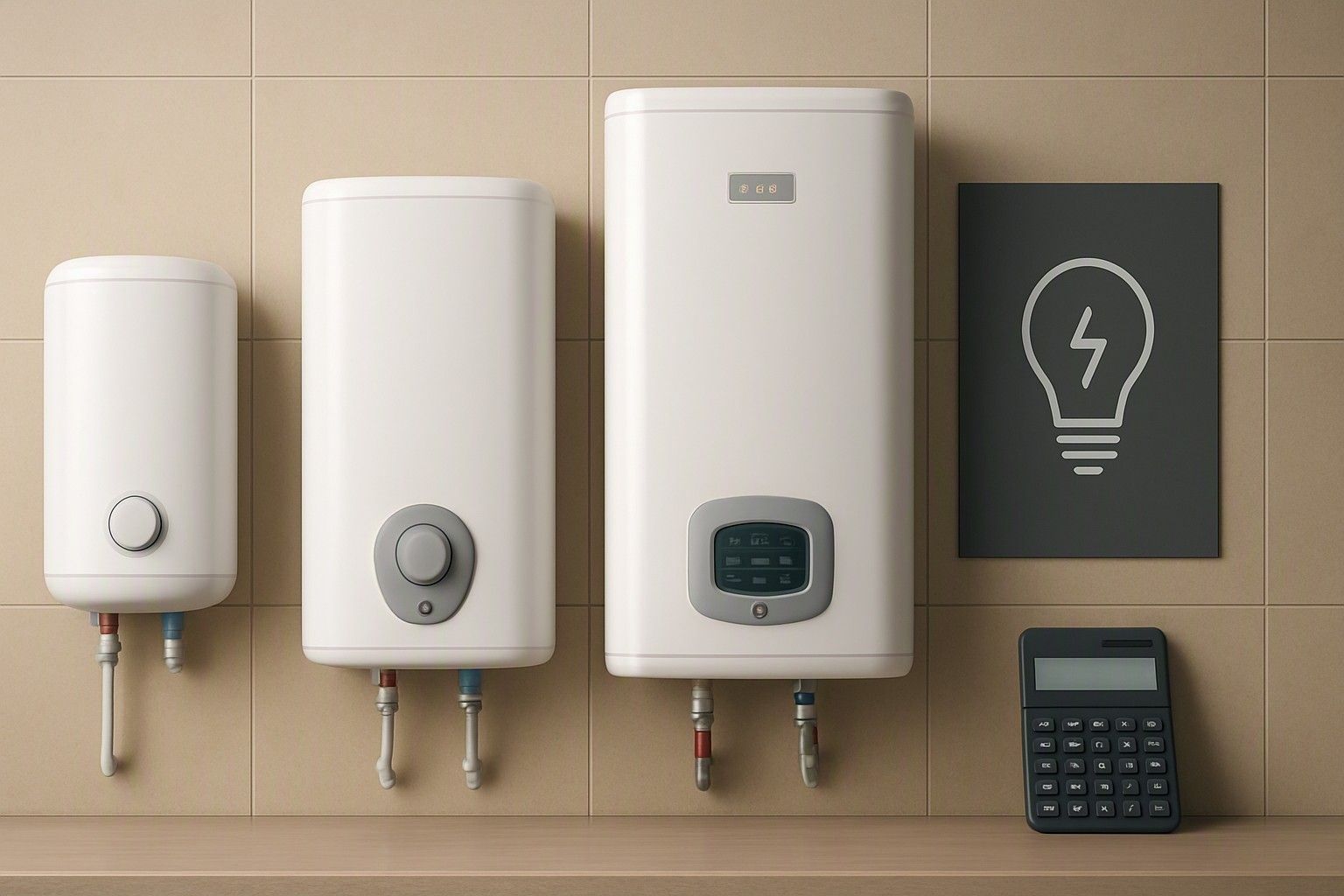
If you're trying to figure out how much a geyser will actually add to your electricity bill, and whether that star rating sticker is worth paying extra for, this is the page that walks through the math. We'll break down wattage, heating time, insulation, and how electric stacks up against gas so the running-cost side of your decision is as clear as the price tag.
Understanding Wattage and Heating Time
Every geyser is rated in watts, and that number tells you how fast it draws power while heating, not how much water it holds. Most storage geysers sold in India sit somewhere between 1500W and 3000W, while instant geysers, which heat water on the fly rather than storing it, often run at 3000W to 4500W because they need to raise the temperature of flowing water almost instantly. A higher wattage means faster heating but also a higher instantaneous load on your home's wiring and meter.
Heating time depends on both wattage and tank size. A small-capacity storage unit with a 2000W element will reach usable temperature faster than a large tank on the same wattage, simply because there's less water to heat. This is why two geysers priced similarly, even within the ₹6,000 range, can behave very differently in daily use if their wattage-to-capacity ratio isn't matched to your household's habits. If your hot water demand is quick and occasional, a lower-wattage unit with a smaller tank keeps running cost down. If you need hot water back quickly for back-to-back use, you'll be paying for higher wattage one way or another, either in the unit's price or in your electricity bill.
The practical point for your buying decision: don't compare geysers on price alone. Check the wattage on the label and think about how many minutes it needs to heat a full tank, because that directly becomes minutes of full-load electricity draw every single day.
What the BEE Star Rating Actually Saves You
The BEE (Bureau of Energy Efficiency) star rating on a geyser measures how much heat is lost while water sits idle in the tank, and how efficiently the unit converts electricity into heat. A 5-star rated geyser insulates better and cycles its heating element less often to maintain temperature, compared to an unrated or 1-star unit of the same capacity. This difference shows up gradually, not as a dramatic one-time saving, but as a lower number of heating cycles per day over months of use.
In practical terms, the star rating matters most if your household uses hot water throughout the day rather than in one or two short bursts. A geyser that's switched on and off for quick use twice a day won't lose much heat to standing loss regardless of its rating, since there's little idle time for heat to escape. But a geyser left on for hours, or used by a larger family across the day, will show a real difference between a well-insulated 5-star model and a cheaper, poorly insulated one.
It's worth being clear-eyed about what star rating doesn't do: it doesn't change how much energy is needed to heat a litre of water from a given starting temperature to a usable one. That's basic thermodynamics and is roughly the same across brands. What it changes is how much of that heated water you lose to standby loss before you actually use it. For most Indian households, the star rating is a genuine factor in long-term cost, but it's a secondary one to wattage and usage pattern, not the whole story.
Estimating Your Monthly Hot Water Bill
You can get a reasonably close estimate of your geyser's monthly cost without any special tools. Take the wattage in kilowatts, multiply by the number of hours the heating element is actually drawing full power each day, then multiply by your electricity board's per-unit rate, and multiply that by 30 days. A 2000W geyser drawing full power for roughly 45 minutes a day, which is typical for a small family's morning and evening use, works out to well under one unit of electricity a day in most cases, but this scales up quickly with family size, tank size, and how many times a day the unit reheats from cold. If you'd rather skip the manual math, the Geyser Electricity Cost Calculator works it out for your exact tank size, star rating and usage pattern.
What trips people up is assuming the geyser runs at full wattage the entire time it's switched on. In reality, once water reaches set temperature, a thermostat cuts the element on and off in short bursts to maintain it, so standing time with the unit switched on doesn't equal standing time at full power draw. This is also where insulation quality, covered next, makes a real difference to your actual bill versus a rough back-of-envelope calculation.
Across the price range you'll find in the market, from ₹1,500 up to ₹25,000 with an average around ₹6,500, the unit's purchase price tells you almost nothing about its monthly running cost on its own. Two geysers in the ₹6,000 bracket can have noticeably different daily electricity draw depending on wattage, tank size, and insulation, so it's worth checking the label specs rather than assuming a higher price automatically means lower running cost.
Insulation and Standing Heat Loss
Standing heat loss is the heat that escapes from stored hot water while the geyser sits idle between uses, and insulation quality is what controls how much of it you lose. Storage geysers use a layer of foam, usually polyurethane, around the inner tank to slow this loss. Thicker, denser foam holds heat longer, which means the thermostat kicks in less often to reheat water that's already been heated once, directly reducing the number of heating cycles and therefore the electricity used per day.
This matters more for households that don't use hot water immediately after heating. If you switch the geyser on right before use and switch it off after, standing loss barely factors in. But if the unit is left on a timer, or kept running through the day for a household with staggered schedules, a poorly insulated tank will reheat far more often than a well-insulated one holding the same volume at the same starting temperature.
Budget units at the lower end, closer to ₹2,000, sometimes cut costs on insulation thickness as a way to hit a lower price point, which is a reasonable trade-off if your usage pattern is short bursts of use rather than all-day standby. If your household keeps the geyser running for extended periods, spending a bit more for better-insulated construction, often found from the ₹6,000 range upward, tends to pay back through fewer reheating cycles over the unit's working life.
Electric vs Gas Running Cost Comparison
Electric geysers and gas water heaters draw on different utilities entirely, which makes a direct cost comparison less about wattage and more about the price you pay per unit of electricity versus per unit of LPG or piped gas in your area. Gas water heaters generally heat water faster and can feel cheaper to run per litre in regions where gas is subsidised or piped gas is available at lower rates, but they carry their own considerations around ventilation, safety fittings, and cylinder or piped-gas availability that electric units don't need to worry about.
Electric geysers, by contrast, are simpler to install, need no flue or ventilation planning, and their running cost is easy to estimate once you know your local electricity tariff, as covered in the previous section. The trade-off is that electricity per unit is often costlier than the energy-equivalent of gas in many Indian cities, though this varies significantly by state tariff structure and whether you're on piped gas or cylinder-based LPG.
Because the true cost comparison depends heavily on local energy prices, appliance efficiency, and how your household actually uses hot water, it's worth taking the time to weigh electric against gas on running cost in more detail before deciding between the two categories. That comparison goes into the fuel-cost side of the decision that this page, focused specifically on electric geysers, doesn't fully cover.
Balancing Efficiency Against Upfront Price
A higher star rating or better insulation almost always comes with a higher purchase price, and the question worth answering before you buy is whether that extra upfront spend actually earns itself back through lower running cost within a reasonable time. For a household with light, occasional hot water use, the efficiency gap between a budget unit near ₹2,000 and a well-rated one in the ₹15,000 bracket may never fully pay back, simply because there isn't enough daily usage to generate meaningful savings from reduced standing loss.
For a larger household with heavy, spread-out hot water demand, the calculation shifts. More heating cycles per day means more opportunities for a well-insulated, efficiently rated unit to save real electricity, and over several years of use, that gap can become significant even after accounting for the higher purchase price. The unit's price history in the market, ranging from ₹1,500 to ₹25,000 with an average around ₹6,500, shows that efficient models are available across the range, so paying more doesn't automatically guarantee better insulation or a higher star rating.
Rather than treating efficiency and price as a simple trade-off, it helps to work out your household's actual daily hot water pattern first, then check the spec label for wattage and star rating against that usage. If you want to think through this upfront-versus-long-term spending question more broadly, it's worth taking a look to see whether paying more upfront is worth it before finalising a budget for your purchase.
Between wattage, star rating, insulation, and how your household actually uses hot water, you now have the pieces needed to estimate what a geyser will really cost you every month, not just what it costs to buy. That's the number that matters more over the unit's lifetime, and it's one you can work out with reasonable confidence before you commit to a specific model.
Comments
Be the first to comment.