How to Judge Recliner Build Quality: Frame, Foam Density and Mechanism Checks
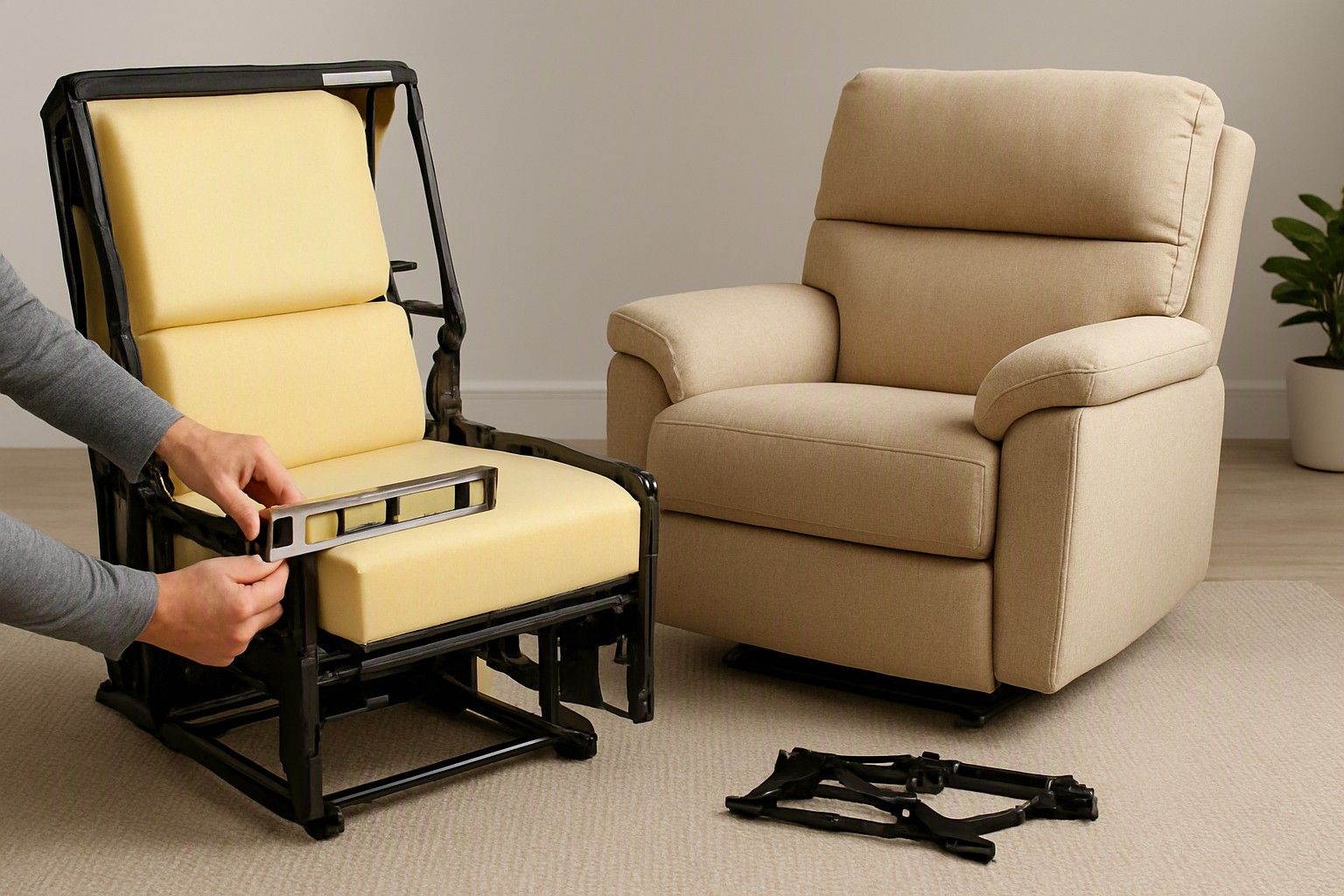
If you are about to pay for a recliner and want to know whether its frame and mechanism will still work smoothly after a few years of daily use, this article is for you. Sagging cushions, creaking joints and a lever that jams are rarely visible in a product photo, but most of them can be spotted with the right questions and a few minutes of testing. Below is a practical checklist you can use in a showroom or on a listing page, so you can decide with confidence today.
Solid Wood, Engineered Wood and Metal Frames
The frame carries your weight every time you sit down and every time the footrest extends, so it decides how long the recliner stays rigid.
Solid wood is the traditional choice. It holds screws well, tolerates repeated stress and can often be repaired. The things to check are whether the wood is properly seasoned and joined with dowels or corner blocks rather than just staples. Poorly dried wood can warp or split, especially in humid coastal cities.
Engineered wood (plywood, MDF or particle board) is common in lower-priced models. Good-quality plywood with thick, layered construction can perform well. Thin particle board is the weak link, because screws loosen in it and it swells if moisture gets in. Ask which type is used and how thick the frame members are.
Metal frames (usually steel) resist warping and handle the mechanism's load well. Look at weld quality, the thickness of the tube or sheet, and whether the finish is coated against rust. Rough, uneven welds or thin tubing flex under load.
Whichever material is used, the frame is only as good as its joints. Ask what holds the corners together, and tilt the chair gently on the shop floor to feel for any twisting.
The Reclining Mechanism: What to Ask the Seller
The mechanism is the part most likely to fail first, because it moves every time you use the chair. Most sellers will describe it only as "manual" or "motorised", which tells you little about durability.
Ask these questions:
- What is the mechanism made of? Thick steel linkages with riveted or bolted joints hold up better than thin stamped parts with plastic bushings.
- Is it a manual lever, a push-back or a motorised unit? Manual mechanisms have fewer parts to fail. Motorised ones add a motor, a controller and a power adapter, all of which need support if they go wrong.
- Is the mechanism made in-house or bought in from a supplier? Neither is automatically better, but the seller should know who to call when it needs service.
- Are spare parts and service available in your city? A mechanism that can be repaired is worth far more than one that needs a full replacement.
- How many recline cycles was it tested for? If the seller has a figure, ask for it in writing. If they have none, treat that as information.
For motorised models, also ask about the backup if the power fails and whether the motor is replaceable on its own.
Foam Density and Cushion Sag
Cushions that look plush in the showroom can flatten into a visible dip within a year if the foam is low-density, the same way a mattress or a favourite sofa loses its shape under daily use. Density, measured in kg per cubic metre, is a better guide to longevity than softness. Softness is a feel; density tells you how much material is packed in to spring back.
Ask the seller for the density of the seat foam specifically, since the seat takes the most load. A higher number generally means a firmer, longer-lasting cushion, though it also changes how the seat feels. Compare the figures between two models you are considering rather than trusting a vague claim such as "high-resilience foam". If a seller cannot state a density, that is a reason for caution.
Also look at how the foam is built. Layered construction, with a firmer core and a softer top layer, usually keeps its shape better than a single slab of soft foam. Check that the foam is wrapped in fibre or a lining so it does not shift or crumble inside the cover.
In the showroom, press the seat hard with your palm, release it and see how quickly it recovers. Then sit for a few minutes and stand up. A deep, lingering impression on a display piece suggests it will only get worse at home.
Weight Capacity for Heavier Users
A recliner puts more strain on its frame and mechanism than an ordinary chair, because the leg rest extends with your weight on a lever arm. If you are a heavier user, or the chair will be shared by people of different builds, the stated weight capacity matters more than any other spec.
Ask for a rated capacity in kilograms and check whether it applies to the whole chair or just the seat. Then leave a margin. If your weight sits close to the stated limit, you will be stressing the mechanism on every recline, which is exactly how joints loosen and linkages bend. Pick a rating comfortably above your weight.
Be wary of listings that give no capacity at all. A vague "sturdy build" is not a rating. Also remember that a person sitting down heavily, or a child bouncing on the footrest, adds momentary load beyond the static figure.
For heavier users, a wider seat, thicker steel or wood in the frame, and denser seat foam work together. A strong frame with soft, thin foam still bottoms out, and dense foam on a weak frame still creaks. Ask the seller whether any of these parts are reinforced for higher loads.
The In-Store Test: Sitting, Reclining and Listening for Creaks
Ten minutes on a display piece tells you more than any brochure. Go through this routine:
- Sit down normally, then drop in a little harder. Listen for creaks, clicks or a sound of wood rubbing on wood.
- Recline slowly all the way back and return. The motion should be smooth, with no catching, jerking or grinding. For a manual lever, the force should be even, not sudden.
- Do it again, five or six times. Some faults only appear after repeated use.
- Rock side to side while seated. Any wobble, twist or play at the joints points to a weak frame or loose fasteners.
- Extend the footrest and press down on it. It should feel firm and lock in place, not bounce or droop.
- Look underneath and behind. Check for neat welds, solid corner blocks, evenly stitched fabric and exposed staples or rough cuts.
- Sit in the fully reclined position for a few minutes. This shows whether the headrest, back angle and leg support suit you.
If the showroom only has a floor model that many people have used, its condition is a fair preview of ageing, so notice any early sag. Ask to see the unit you will actually receive, or ask for a written assurance that it matches the display model.
Red Flags in Online Listings
You cannot sit on a chair through a screen, so the listing itself has to do the work. Start with what is missing. A listing that names only "premium material" without saying what the frame is made of, gives no weight capacity and no foam density, and shows only styled photos, is hiding the details that matter.
Other warning signs include:
- Mechanism described only as "smooth recline" with no type or material.
- No mention of frame thickness or joinery.
- Reviews that praise looks and delivery but never mention how the chair holds up after months.
- Photos that never show the underside, the mechanism or the back panel.
- Vague or missing warranty terms.
Price is another clue. Recliners across this category run from ₹7,500 to ₹60,000, with an average around ₹18,000. A chair listed in the ₹10,000 tier can still be sound if the seller is transparent about its materials, but a motorised, leather-look model priced at the very bottom of the range has to cut costs somewhere, usually in the frame, foam or mechanism. It helps to spot a price that is too low for the build it claims before you add anything to your cart.
When in doubt, message the seller with your frame, foam and capacity questions. A clear, specific reply is a good sign; an evasive one is a better answer than you wanted.
What the Mechanism Warranty Should Cover
A warranty is the seller's own estimate of how long the build will last, so read it as closely as you read the spec sheet. A single line saying "one year warranty" is not enough. You want to know what is actually covered.
Check these points:
- Frame and mechanism listed separately. Many warranties cover the frame for longer than the mechanism, and some exclude moving parts as "wear and tear". Ask which applies.
- Motor and electronics, if any. Motorised units should name the motor, controller and adapter as covered parts.
- Repair or replace. Find out whether the seller repairs the fault, replaces the part or replaces the whole chair, and who pays for pickup and delivery.
- Exclusions. Watch for clauses about "improper use", uneven floors or exceeding weight capacity, and make sure you know what each one means in practice.
- How to claim. A local service contact, a phone number that works and a clear process matter more than a long term on paper.
Keep the invoice and take photos of the chair on delivery. For a closer look at reading the fine print on frame and mechanism cover, including what upkeep might affect a claim, the care and warranty guide goes through the typical clauses in detail.
Turning Build Checks Into a Shortlist
Once you have looked at a few recliners, put the findings side by side so you are comparing facts rather than impressions. For each chair, note the frame material and joinery, the mechanism type and who services it, the seat foam density, the rated weight capacity and the warranty terms for frame and mechanism. Add how it felt in the sit-and-recline test, and mark any gaps where the seller could not or would not answer.
Then narrow the list. Drop any chair where the seller could not state basic specs, where the mechanism felt rough or the frame moved, or where the warranty excluded the parts most likely to fail. What remains is a shortlist of chairs that are plausible for the long term, and price can then act as the tie-breaker within your tier, whether that is ₹20,000 or ₹35,000.
Build quality is only one part of the decision. Size, upholstery, features and room fit matter too, and you can put these build checks beside everything else worth comparing in the main buying guide before you commit.
You now have what you need to answer the question: check what the frame is made of and how it is joined, ask about the mechanism and its servicing, compare foam density and weight ratings, test the chair for smoothness and creaks, and read the warranty for what it actually covers. A recliner that passes those checks is far more likely to stay solid and smooth, and you can buy it at today's price knowing why.
Comments
Be the first to comment.