Recliner vs Regular Sofa: Which Suits Your Living Room Better?
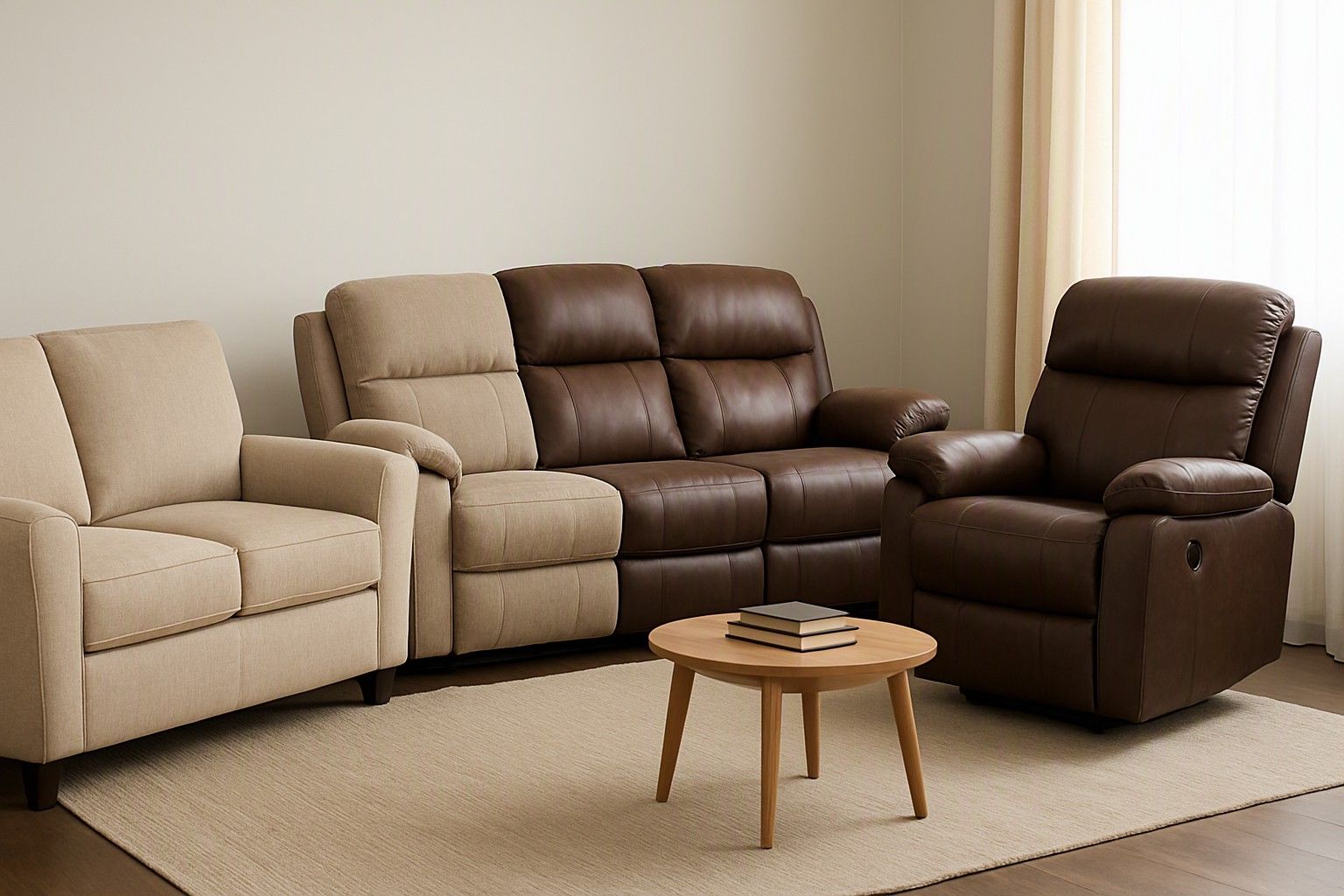
If you are deciding between a recliner and a normal sofa for your living room, the short answer is that it depends on who sits there, how often, and how much floor you can spare. A recliner wins on lying-back comfort for one person. A regular sofa wins on seating several people, on simplicity and on how little space it needs. This article compares the two on space, comfort, cost per seat and upkeep, so you can settle the question before looking at any specific recliner.
What a Recliner Does That a Fixed Sofa Cannot
A fixed sofa gives you one posture: upright or slightly slouched, with your legs hanging down or tucked beside you. A recliner changes that. The backrest tilts back, a footrest lifts your legs, and in many designs you can stop at several angles between sitting and nearly lying down. That support under the calves and knees is the real difference, and no amount of cushions on a regular sofa recreates it.
This matters most for particular people. Someone who comes home from work and wants to stretch out in front of the TV, an older parent with stiff knees or a sore lower back, or anyone who dozes off after lunch will notice the change. A recliner also gives each person a defined seat, so nobody ends up folded into a corner.
The trade-off is that a recliner is built around one person lying back. A fixed sofa is built around sitting together, and you can also sit sideways, perch on the arm or lie across it. If your living room is mainly where people gather, that flexibility counts for a lot. If it is mainly where one or two people unwind, the recliner's specialised comfort is hard to match.
Floor Space: Reclining Clearance vs a Fixed Sofa's Footprint
A fixed sofa takes up the space you see: its width and depth, and nothing more. A recliner takes up that space plus whatever it needs to move. The backrest swings back, the footrest swings out in front, and the seat sometimes slides forward. So a recliner that looks compact when closed can take up much more floor when fully open. Many Indian living rooms also have to fit a TV unit, a centre table, a side table and sometimes a diwan or dining area, so this extra footprint is often what decides the choice.
The practical test is to measure the recliner in its fully extended position, not at rest. Check that the footrest will not hit the centre table and that the backrest has room to tilt without hitting the wall or blocking a door. Some designs need a gap behind them, while others are made to sit close to the wall. For a clearer picture of how much wall gap a reclining seat really needs, it helps to work through your room dimensions against the seater size before deciding.
If your room is compact and the sofa also has to work as a walkway-side seat, a fixed sofa is the safer fit. If you have a clear stretch of floor in front of the TV, a recliner fits more easily.
Comfort for Long TV Hours, Afternoon Naps and Visiting Guests
Comfort changes depending on what you are doing, so it helps to look at three situations separately.
Long TV hours. A recliner is clearly better here. Leg support and an adjustable back angle reduce the restlessness that comes with sitting upright through a two-hour film or a cricket match. A fixed sofa gets uncomfortable sooner, and people end up shifting and adding cushions.
Afternoon naps. A recliner lets you lie back with your legs raised without leaving the living room or making up a bed. A regular sofa only works for a nap if you stretch across it, which then takes the whole sofa.
Visiting guests. This is where the fixed sofa wins. A three-seater can take three adults, or more at a squeeze during festivals and family visits. A recliner seats one person, and guests are often unsure how to use it or reluctant to lean back in someone else's house.
So the answer depends on your household. If it is mostly the same few people daily, a recliner pays off in comfort. If guests are frequent and numerous, a fixed sofa carries more of the load.
Cost Per Seat Compared
Recliners cost more per seat than a fixed sofa of similar size and upholstery, because you are paying for the mechanism, the extra frame strength and the footrest assembly on top of the seat itself. Across this category, prices run from ₹7,500 to ₹60,000, with an average of ₹18,000. The main budget bands are ₹10,000, ₹20,000 and ₹35,000.
It helps to think in seats rather than in total price. A fixed three-seater gives you three places to sit for one price. A recliner at ₹18,000 typically gives you one place to sit, at a much higher comfort level. A set with every seat reclining multiplies the mechanism cost across the whole set, which is why it sits toward the upper end of the range.
The useful question is not which is cheaper but which cost matches how you will use the seat. If one family member will use the recliner daily for years, the cost per hour of comfortable use is low. If it will mostly sit empty while guests crowd onto other seating, you have paid for comfort that goes unused. The prices above are what this category typically costs today, so you can set a budget and decide now.
Upkeep: Moving Parts vs a Simple Frame
A fixed sofa has little that can fail apart from the cushions and the upholstery. Foam flattens over time, fabric wears and stains, and a frame joint may loosen eventually, but there are no parts that move on every use. Cleaning and occasional re-upholstery are most of what it needs.
A recliner adds a mechanism, and anything that moves gets used, loosened and worn. A manual lever or handle can stiffen or become loose. An electric version adds a motor, a wiring path and a power point near the seat. Dust, loose coins and small objects falling into the gap can also hamper the mechanism, and children treating the footrest as a swing can strain it. Keeping it working means simple habits: not overloading it, not forcing it shut, and keeping the moving area clear.
Before you commit, read up on the ongoing upkeep a reclining mechanism asks for, including what a warranty usually covers and what it leaves out. If you want a sofa you can ignore for years, a fixed one is simpler. If you accept a little care in exchange for comfort, a recliner is manageable.
The Middle Path: Sofa Sets With One or Two Reclining Ends
You do not have to choose entirely. Many households settle on a sofa set where most seats are fixed and one or two end seats recline. A common arrangement is a three-seater with a reclining seat at each end and a fixed seat in the middle, or a fixed two-seater paired with a single recliner.
This works because it follows how the room is actually used. The person who watches TV the most gets the reclining seat, while the fixed seats take extra people when guests arrive. It also keeps the mechanism count, and therefore the cost and upkeep, lower than an all-recliner set. The compromise is that you still need clearance at the reclining ends, and the fixed middle seat will feel firmer and less adjustable than its neighbours.
If this middle option sounds right for you, the fuller checklist of recliner decisions for Indian homes covers the next steps, from seater count and upholstery to mechanism type and the questions to ask before you buy.
If your living room is mostly where one or two people relax for hours, and you have clear floor in front of the TV, a recliner is worth its higher cost per seat. If it mainly hosts groups, has tight dimensions, or you want minimal upkeep, a regular sofa fits better. A set with one or two reclining ends sits between the two. With your room measurements and household habits in hand, you can make this choice today.
Comments
Be the first to comment.