Manual vs Motorized Recliners: Effort, Power Cuts and Repair Risk
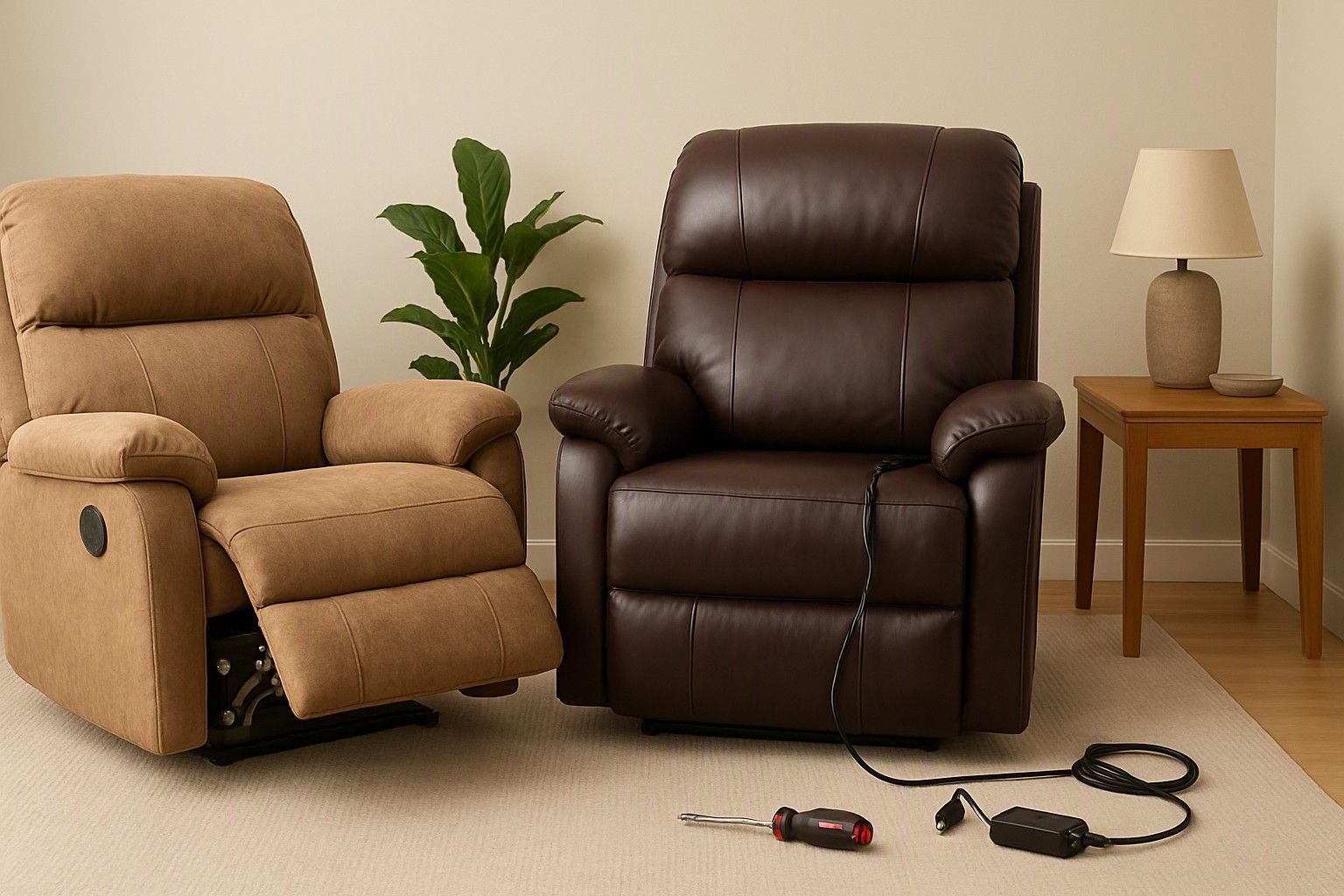
If you are choosing between a manual and a motorized recliner for an Indian home, the short answer is that motorized is worth it only when someone in the house struggles to operate a lever or push-back, and when you have a plan for power cuts. For a healthy adult on a tighter budget, a well-built manual recliner is usually the safer, simpler buy. This guide walks through effort, outages, repair risk and cost so you can decide today.
How Lever, Push-Back and Motorized Reclining Work
A lever recliner has a handle or pull-tab on the side. Pulling it releases the mechanism, and you lean back while the footrest rises. Pushing the footrest down and shifting your weight forward closes it again. Most manual recliners reach only a few fixed positions.
A push-back recliner has no handle at all. You press your back against the backrest and extend your legs, and your body weight drives the recline. It looks cleaner and avoids a protruding lever, but it needs some leg and back strength to start and to return upright.
A motorized recliner uses an electric motor, usually called an actuator, to move the backrest and footrest at the press of a button or a small remote. The motor does the lifting, so your body weight and strength barely matter. It also needs a power source, normally a plug-in adapter connected to a wall socket.
The real difference is where the work comes from: your muscles in the first two types, and mains electricity in the third. Every other trade-off in this article follows from that.
Effort and Ease for Different Family Members
For most adults, a lever recliner takes a light pull and a small lean. That is no trouble for a healthy person, but it can be a real obstacle for others in the same house.
Children often cannot generate enough force to open or close a manual recliner, and they may pinch fingers in the footrest linkage. Older family members face a different problem: closing a manual recliner means pushing the footrest down with their legs, which is hard with weak knees, hip pain or a stiff lower back. Push-back designs ask the most from the body, since the recline starts from your own pressure.
A motorized recliner removes that effort. One button moves you up or down at a steady pace, with no jerk at the end of the motion. That smoothness matters when standing up is already painful, which is covered in more detail in why one-touch motors suit parents with knee or back pain.
If everyone using the chair is fit and comfortable with a lever, manual operation gives up nothing in comfort. If even one regular user finds the lever or the closing push difficult, that person's needs should decide the choice, not the average of the household.
Power Cuts, Inverters and Battery Packs
Power cuts are the main worry with motorized recliners in India, and it is a fair one. When the supply drops, a plain plug-in motor stops where it is. If you were reclined, you may be stuck at that angle until power returns.
There are three practical ways to handle this. First, if your home has an inverter that powers the room's sockets, the recliner's small adapter draws very little power and can usually run on it. Check that the socket you plan to use is actually on the inverter circuit before you place the chair.
Second, some motorized models offer a rechargeable battery pack as an option or accessory. Ask the seller whether it is available for the specific model, what it costs, and whether replacements can be bought later.
Third, ask whether the model has any manual release or emergency lowering feature. Not all do, and you should not assume it.
If your area has frequent, long outages and you have no inverter or battery backup, a manual recliner removes the risk entirely. If outages are short and you have backup, the problem is easy to manage.
Repairs: Motor and Wiring Faults vs Cable and Spring Wear
Manual and motorized recliners fail in different ways, and repair access matters as much as the fault itself.
A manual recliner wears through mechanical parts: the release cable or handle linkage, springs, pivot joints and rivets. These problems often show up gradually, as a stiffer lever, a squeak or a footrest that no longer locks firmly. A local furniture workshop can often fix or replace such parts, since they are mechanical and visible.
A motorized recliner adds electrical parts that can fail: the motor or actuator, the control switch or remote, the adapter and the wiring. A dead button or a faulty adapter can leave the chair stuck, and diagnosing it usually needs a technician who knows the system. Spares may need to come from the seller or manufacturer, so ask about service support in your city before buying.
Both types still depend on the same steel frame and linkage underneath. A weak mechanism will fail sooner regardless of how it is powered, so read what separates a durable reclining mechanism from a weak one before you compare operation types. A well-built manual chair can outlast a poorly supported motorized one.
Extras: USB Ports, Memory Positions and Infinite Positioning
Motorized recliners often come with extras that manual ones cannot offer, but each should be judged on whether you would use it daily.
USB ports let you charge a phone beside the chair. This is handy, but a power strip near the chair does the same job, so it should not drive the decision.
Infinite positioning means the backrest and footrest can stop at any angle instead of a few fixed ones. For reading, watching television, or relieving back pressure, this is a genuine comfort gain. Manual recliners typically offer only a handful of locked positions, which suits many people fine but may leave you between two angles that are not quite right.
Memory positions store a favourite angle so you can return to it with one press. This is useful if two people share the chair and prefer different settings, though many buyers never use it after the first week.
These features are also extra electronics, which means more parts that could need servicing. Choose them only if you will use them, and ask what happens to the main recline function if the extra feature stops working.
The Price Gap Between Manual and Motorized Models
Recliners in this category run from ₹7,500 to ₹60,000, with an average of ₹18,000. Manual recliners dominate the lower end, and motorized models cluster higher because of the motor, controls and wiring.
In the ₹10,000 range, expect manual lever or push-back designs. Here the focus should be on the sturdiness of the frame and mechanism rather than extra features. In the ₹20,000 range, you will see better manual recliners and the first motorized options, though these may be simpler in finish and feature set. In the ₹35,000 range, motorized recliners become far more common, with more upholstery choices and extras such as USB ports or multiple positions.
Treat the extra cost of motorization as paying for ease of use, not for durability. If a family member needs the motor, that spend is well placed. If nobody does, the same money may buy a sturdier frame or better upholstery in a manual model.
Also factor in the cost of backup power if you lack an inverter, and the possibility of paying for electrical repairs later. Prices today reflect what this category typically costs, so decide on need rather than timing.
Which Operation Type Fits Your Household
Match the operation type to the least capable regular user of the chair, then check your power situation.
Choose a manual lever recliner if all users are comfortable pulling a lever and pushing the footrest closed, outages in your area are frequent or long, you have no backup power, or you want the lowest cost and the simplest repairs.
Choose a push-back model if you prefer a clean look with no handle and everyone using it has enough leg and back strength to start the recline without strain.
Choose a motorized recliner if someone has knee, hip or back pain, limited strength, or needs steady, controlled movement, and you have an inverter or battery option and service support nearby. Infinite positioning and memory settings are a bonus, not the reason to buy.
If you are undecided, a manual recliner with a robust mechanism is the lower-risk starting point, because it keeps working in any outage. Once you have settled on the operation type, the upholstery, size and frame choices that sit alongside this one will help you complete the decision.
So, is a motorized recliner worth it over a manual one in India? Yes, if someone in the house needs the effortless movement and you can cover power cuts with an inverter or battery option. If not, a sturdy manual recliner gives you reliable comfort with fewer things to go wrong. Pick based on who will use it and how your power supply behaves, and you can buy with confidence now.

Comments
Be the first to comment.