Will a Recliner Fit Your Flat? Room Measurements, Wall-Hugger Designs and Seater Options
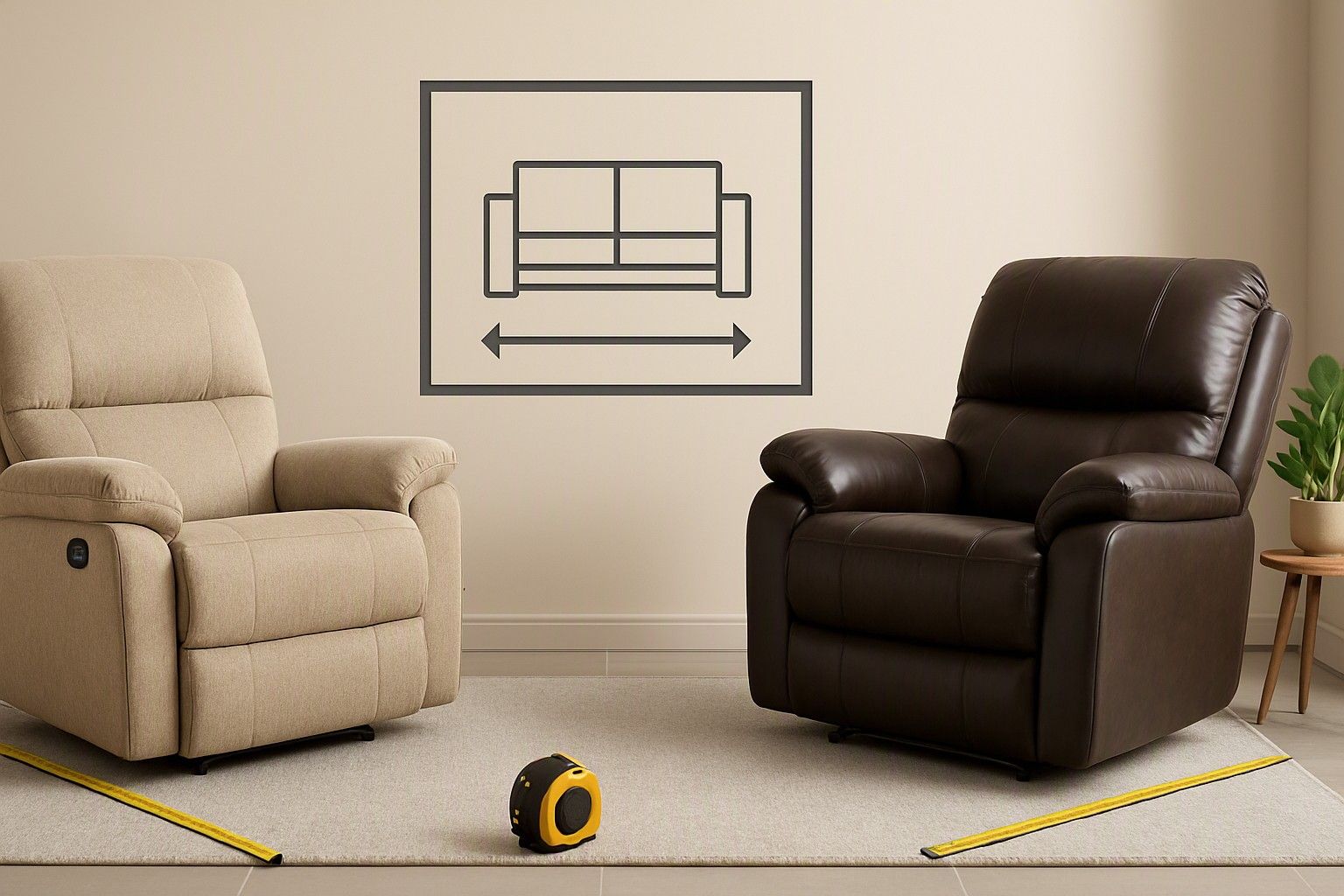
If your living room is compact, a recliner fits only when you have measured it in three states: upright, fully reclined and with a walkway left around it. This guide takes you through those measurements, wall-hugger designs, and the single-seater versus 3-seater question, so you can decide with a tape measure in hand rather than guess from a product photo.
Measuring Your Room: Upright, Fully Reclined and Walkway Space
A recliner takes up very different amounts of floor depending on whether you are sitting upright or lying back with the footrest out. Most buyers measure only the upright footprint and then find the reclined chair blocking the balcony door or the path to the kitchen.
Take three measurements before you look at any listing:
- Upright footprint: the width and depth of the spot where the chair will stand, including the wall behind it.
- Fully reclined length: the distance from the wall to the tip of the extended footrest. Listings usually give a reclined depth; if one does not, ask the seller before ordering.
- Walkway clearance: the path people use every day, such as door to sofa, or sofa to balcony. Keep roughly a shoulder-width gap, about 60 to 75 cm, free even when the chair is fully reclined.
Mark the reclined outline on the floor with masking tape or newspaper, then walk around it as you would on a normal evening. Check where the door swings, where a centre table or TV unit sits, and whether the footrest would reach a curtain, a fan stand or a shoe rack. If the taped outline blocks a door or a main path, that size is wrong for the room, however good the chair looks.
Wall-Hugger vs Standard Recliners in Compact Flats
Standard recliners tilt the backrest back as they recline, so they need a good gap behind them. In a flat where the sofa sits flush against the wall, that gap often does not exist, and the backrest hits the paint or skirting before the chair is fully back.
Wall-hugger designs solve this by sliding the seat forward as the backrest tilts, so the chair can sit only a few inches from the wall and still recline. The trade-off is that the seat moves forward, which means more floor space is needed in front of the chair. For a room that is narrow but long, that is usually a good exchange. For a square room with a centre table close to the seating, the forward travel can be the problem.
A standard recliner makes sense when you have a free corner or can float the chair a little away from the wall, and it is often the more familiar and widely available build. A wall-hugger is the safer pick when the chair must sit against a wall, in a bedroom corner or along a short living-room wall. Whichever you choose, compare the listed reclined depth and the recommended wall gap rather than the label alone, because the amount of clearance needed differs from model to model.
Single-Seater, 2-Seater, 3-Seater or a Mixed Set
In a compact flat, seat count is mostly a floor-space decision, and price follows it. Recliners in this category run from ₹7,500 to ₹60,000, with an average recliner price around ₹18,000, and more seats generally push you further up that range.
Single-seater: the easiest fit. It suits a corner, a bedroom or a balcony-facing spot, and it leaves room for other furniture. The downside is that it seats one person, so family movie nights need extra seating.
2-seater: works for couples in a medium living room, but each seat usually reclines separately, so you need the full reclined depth plus enough width for two people to recline at once.
3-seater: gives full family seating, but it is the hardest to fit, the heaviest to move and the most demanding on wall length. If a 3-seater leaves less than a comfortable walkway beside it, it is too big for the room.
For many small flats, the most practical answer is one recliner paired with a fixed sofa or loveseat. If you are weighing up mixing reclining and fixed seats in one living room, this gives the family a place to sit while one person gets the full recline, and it keeps the room less crowded than a full row of recliners.
Seat Width, Depth and Height for Different Body Sizes
A recliner that fits the room but not the person gets used for a week and then ignored. Three seat dimensions decide comfort.
Seat width: you should be able to sit without your hips pressing against the arms. Broader builds usually need a wider seat, while a narrow seat suits smaller frames and tighter rooms.
Seat depth: this affects your thighs and knees. If you are shorter, a deep seat leaves your feet hanging or pushes you to sit forward, away from the backrest. If you are tall, a shallow seat leaves your thighs unsupported. Ideally, the back of your knees should sit just clear of the seat edge.
Height: check the backrest and headrest. Taller people need a backrest that supports the shoulders and a headrest that reaches the head when reclined. Shorter people should check that their feet reach the floor when upright, and that the footrest does not leave their legs dangling or overextended when it is out.
A bigger chair is not always more comfortable. If two people of very different heights will share one recliner, favour a medium depth with a good headrest, and read the listed seat dimensions rather than relying on the word large or compact.
Getting It Through the Door, Lift and Stairwell
In many Indian apartments the chair has to survive the journey before it can recline anywhere. Narrow lifts, tight stair turns and 30-inch-wide internal doors are common, and a 3-seater that fits the living room may still not fit the entrance.
Measure the main door width, the lift's door opening and inner depth, and the tightest turn on the stairs if the lift is out of order or too small. Then compare these to the packed dimensions of the recliner, not just the assembled size. Boxed units are often longer or taller than the finished chair.
Ask the seller whether the backrest or arms detach, because some recliners ship in separable sections and are assembled in the room, which helps a lot in narrow buildings. Also ask whether the delivery team will carry it up stairs, and check the society's rules about delivery timings and lift use.
If the numbers are close, a smaller seat count or a modular design is safer than hoping the chair will tilt through. Check the diagonal clearance too, since a chair can often go through a door at an angle that a flat measurement would rule out, but only if the hallway allows the turn.
Socket Placement for Powered Models
A powered recliner needs a nearby socket, and the cable usually does not stretch far. In a flat where sockets sit at the TV wall or beside the bed, the chair may end up in a spot that is in the wrong place for the cord, leaving a wire running across the walkway.
Mark where the chair will sit, then find the closest socket. Check the cable length listed for the model and plan for the cable to run along the wall or behind the chair, not across the floor where feet and the footrest will catch it. Keep the socket where it is easy to reach, since you may need to unplug during storms or when cleaning.
Avoid long extension cords stretched across the room and avoid overloading a point that already powers a TV and set-top box. If no socket is convenient, you may need an electrician to add a point, which is an added cost and a wall job you should settle before buying.
If the socket is a real obstacle, it helps to think about whether a powered recliner is worth routing a socket for, because a manual model removes the cable question entirely and gives you more freedom to place the chair.
Final Room-Fit Checks Before Ordering
Run through this short checklist before you pay, using the tape measure one last time.
- The upright footprint fits the chosen spot with a few centimetres to spare on each side.
- The fully reclined outline, marked on the floor, does not block a door, a main path or a piece of furniture.
- For a standard recliner, the wall gap the model needs is actually available; for a wall-hugger, the forward travel clears the centre table.
- The seat width, depth and headrest suit the people who will use it most.
- The packed size clears the main door, the lift and the stair turns, and you know who will carry it up.
- For a powered model, a socket is within easy reach of the cable without crossing the walkway.
- The return and replacement terms cover a size mismatch, in writing.
Prices span ₹7,500 to ₹60,000, and the average sits near ₹18,000, so a recliner that fits your room properly is worth choosing now rather than compromising on size to hit a number. Once the dimensions are settled, you can match the size you have measured against upholstery and mechanism choices and narrow the shortlist with confidence.
If you have the three measurements, the door and lift numbers and a socket position, you can answer the original question yourself: a single-seater or a wall-hugger usually suits a tight flat, a 3-seater only suits a room with real wall length and a wide entrance, and a recliner plus a fixed sofa is the practical middle path. Choose the size that clears your walkway when fully reclined, and the rest of the decision becomes much simpler.
Comments
Be the first to comment.