Water Purifier Certifications and Red Flags to Check Before Buying
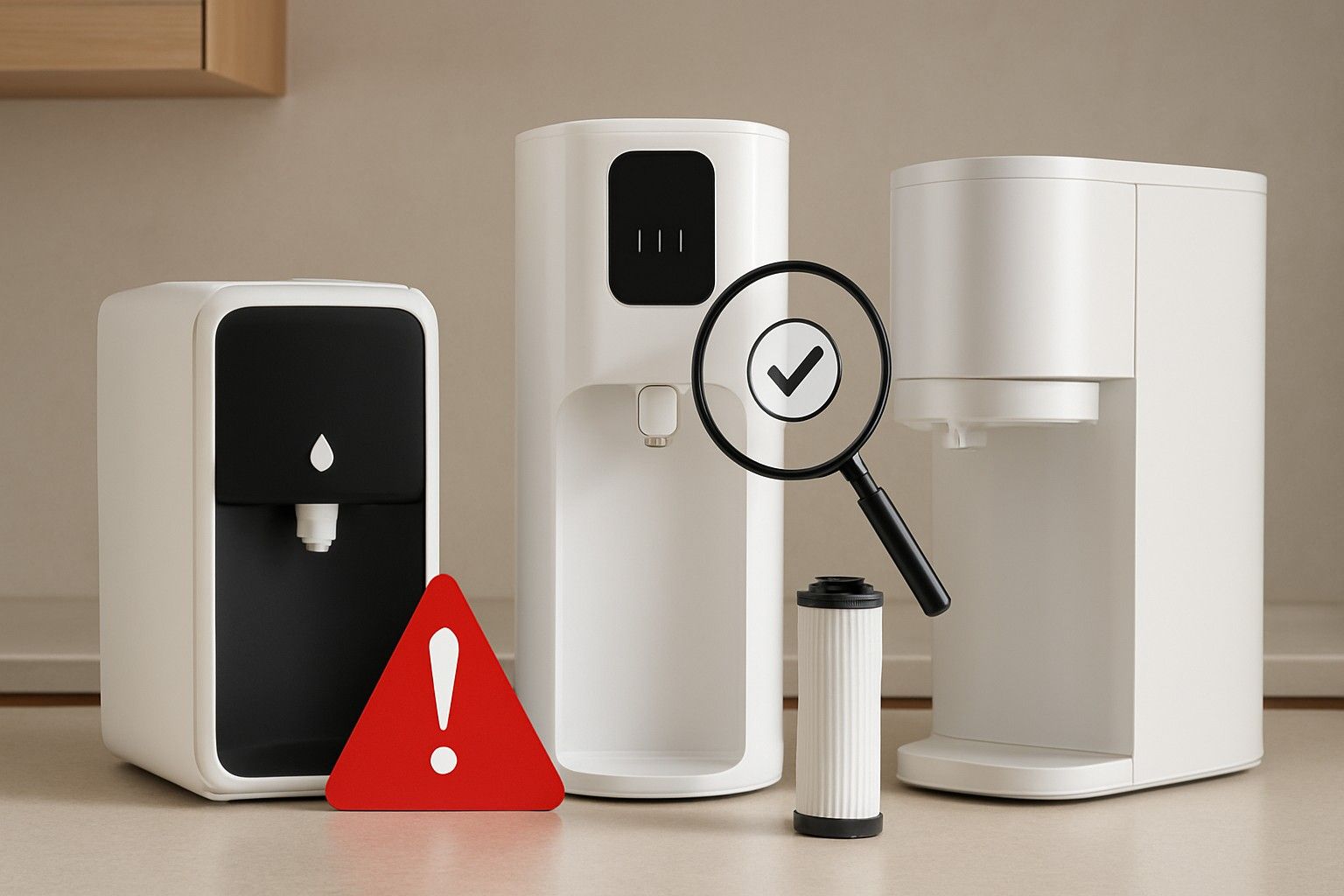
If you're standing in a store or scrolling a listing wondering whether that "ISI certified" sticker or "NSF approved" claim actually means anything, you're asking the right question before you pay. India's water purifier market has genuine certification bodies alongside a fair number of vague or outright fabricated claims, and telling them apart takes about five minutes once you know what to look for. This article walks through exactly that — the certifications worth trusting, the marketing language worth ignoring, and the checks that protect you after the purchase too.
ISI, WQA and Other Certifications That Matter in India
In India, the certification that carries the most legal weight is the BIS (Bureau of Indian Standards) mark, sometimes still referred to loosely as ISI certification, which applies to the overall product safety and build compliance. For water treatment performance specifically, look for testing against IS 10500 (the Indian drinking water standard) — a purifier that states it has been tested to this standard is telling you something concrete about what contaminants it actually removes, not just that it exists as a product. WQA (Water Quality Association) is a US-based body, and a genuine WQA Gold Seal or similar mark on an Indian-market unit usually reflects component-level testing done by the manufacturer, which is a positive sign but not a substitute for local BIS compliance. NSF certification works similarly — it's a legitimate international standard, but it should appear alongside, not instead of, Indian regulatory compliance. What you want as a buyer is a specific certificate number or test report you can ask the seller to show, not just a badge printed on the box. A purifier priced anywhere from ₹1,799 to ₹38,990 can carry genuine certification — price alone doesn't guarantee it, and a unit near ₹9,499 with proper paperwork is a safer bet than a cheaper one with none.
Misleading Marketing Claims to Watch For
Terms like "100% pure," "removes all bacteria," or "hospital-grade purification" sound reassuring but mean nothing in isolation because they aren't tied to any measurable standard or test method. A genuine claim will reference a specific reduction percentage against a specific contaminant — for example, stating a defined log reduction for bacteria or a specific TDS reduction range — rather than an absolute, unqualified promise. Watch for phrases like "WHO approved" or "ISI approved technology,” since neither the WHO nor BIS certifies purification technology in this generic way; they certify specific products against specific tests, so a vague reference to either body without a certificate number is a signal to ask more questions. Another common trick is highlighting the number of filtration "stages" as if more automatically means better — a seven-stage purifier isn't inherently superior to a five-stage one if some of those stages are just structural mesh or non-functional layers counted for marketing purposes. Similarly, claims about mineral retention or "alkaline water" benefits are largely unregulated wellness language rather than certified health claims, so treat them as a preference feature, not a safety one. If a listing leans heavily on adjectives and light on numbers or certificate references, that imbalance itself is the red flag worth noticing before you commit to paying anything toward that ₹1,799 to ₹38,990 range.
Spotting Counterfeit and Local-Assembled Units
Counterfeit and locally assembled purifiers are a real problem in the Indian market, particularly in the lower price bands and on marketplaces where third-party sellers list products under a recognizable brand name without the manufacturer's actual quality control. A few practical checks help here. First, ask for the invoice to explicitly name the brand, model, and GST details of the seller — a genuine authorized dealer will provide this without hesitation, while a reseller of a locally assembled unit often gets vague about it. Second, check whether the serial number or QR code on the unit can be verified through the brand's official app or website; this single step catches a large share of counterfeit sales. Third, be wary of a unit priced dramatically below the rest of the market for that stated brand and spec combination — something listed well under the ₹2,999 range while claiming multi-stage RO+UV+UF purification with a name-brand pump is more likely a local assembly using a genuine-looking outer shell than a real deal. Finally, genuine units almost always come with a warranty card that's activatable online or via a service call; if the seller can't explain how you'll register the warranty, that's a strong sign the supply chain isn't official, regardless of how convincing the box looks.
Common Mistakes First-Time Buyers Make
The most frequent mistake is buying based on the technology name alone — assuming RO is always necessary or always superior — without first checking the actual TDS and hardness of the local water supply. Many first-time buyers in low-TDS municipal supply areas end up paying for heavy multi-stage RO systems they didn't need, when a simpler UV or UF unit would have handled the job at a noticeably lower price point and with far less ongoing maintenance. It helps to actually understand your water source before comparing models, so you can avoid overpaying for an RO you may not need and instead match the purification technology to your specific water quality. A second common error is treating the sticker price as the full cost, without factoring in filter replacement frequency or membrane life, which can add up substantially over the ownership period regardless of which budget tier the unit falls into. A third mistake is skipping the demo or installation check entirely and assuming any purifier works the same out of the box — flow rate, storage capacity, and fit within your kitchen space vary enough between models in the ₹9,999 range that a quick in-person check before final payment saves real frustration later.
Checking Service Network and Warranty Coverage
A certified, genuine purifier is only as good as the service network standing behind it, and this is where many buyers focus entirely on the upfront number while ignoring what happens six months in. Before paying, confirm whether the brand has an authorized service center or technician network actually operating in your city or town, not just a national customer care number that eventually routes you somewhere distant. Ask specifically what the warranty covers — typically the pump, motor, and electronic components — versus what's treated as a consumable and charged separately, since filters and membranes are almost always excluded from the base warranty regardless of price tier. It's worth asking the seller directly to walk you through expected annual service costs so you can factor in service visits and filter warranty into your total ownership decision rather than being surprised later. A unit at the lower end near ₹2,999 may have a shorter or more limited warranty period than one in the ₹21,999 range, and that difference matters more over a multi-year ownership span than it appears at the point of sale. Get the warranty terms in writing or via the official app registration, not just a verbal assurance from the salesperson.
A Final Checklist Before You Pay
Before you complete the purchase, run through a short mental list: does the unit show a specific test standard reference rather than vague purity language, can you verify its serial number through an official channel, does the invoice name a real authorized seller with proper tax details, and is there a working local service option for warranty claims? If any one of these comes back uncertain, it's worth pausing rather than proceeding, regardless of how attractive the price looks against the broader ₹1,799 to ₹38,990 range in the market. It also helps to confirm the technology actually suits your water source rather than being sold on brand reputation alone, and to have a clear sense of ongoing filter and service costs before you commit. For a broader view that ties all of this together with the rest of the decision — budget, technology type, and capacity — you can run through the complete buying checklist once more before finalizing anything. None of this needs to take long, but skipping it entirely is exactly how counterfeit units and uncertified claims find their way into Indian homes.
Certifications and paperwork aren't the exciting part of buying a water purifier, but they're the part that determines whether the unit actually does what it claims once it's installed in your kitchen. With a genuine BIS or IS 10500 reference, a verifiable serial number, a real invoice, and a service network you can actually reach, you're no longer guessing — you're buying with the same confidence whether the unit costs ₹2,999 or sits closer to ₹21,999. That's the real answer to whether a purifier is safe to buy: not the price tag, but whether it can survive these checks.
Comments
Be the first to comment.