Water Purifier Installation and Space Requirements at Home
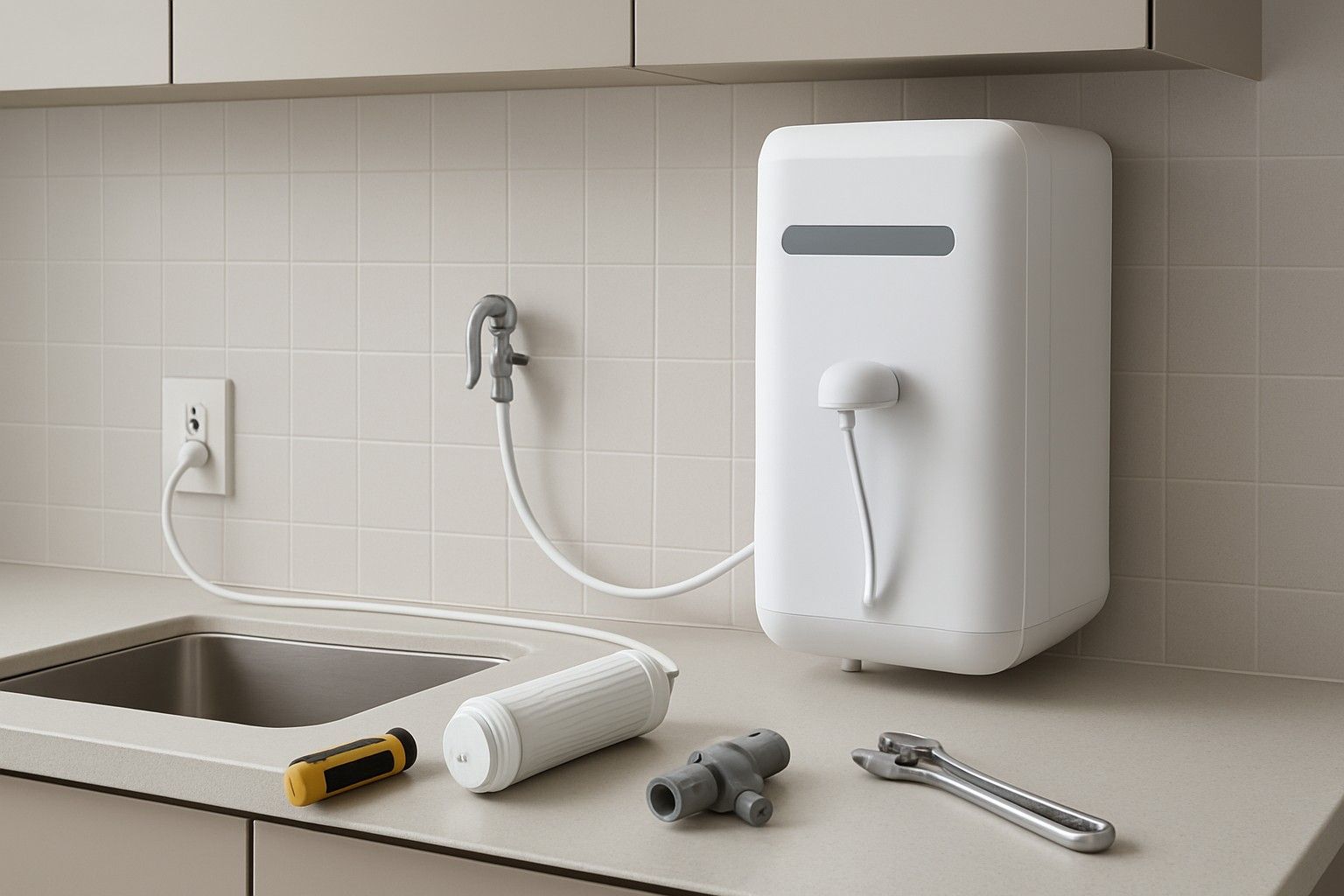
Before you finalise a water purifier, it's worth checking whether your kitchen can actually accommodate it — the wall space, incoming water pressure, drainage and electrical socket all matter as much as the filtration technology. This article walks through exactly what to check and arrange so installation day goes smoothly instead of turning into a surprise renovation. If you've already shortlisted a model and just want to confirm it'll fit and function in your home, this is the right stop.
Wall-Mount vs Countertop vs Under-Sink Placement
Most RO and UV/UF purifiers sold in India are designed for one of three placements, and each comes with its own space math. Wall-mounted units are the most common — they're screwed into the wall above the counter, usually near the sink, and need roughly 20-25 cm of clear wall width plus enough drop height below for a dispensing glass. This works well if your kitchen has tiled wall space free of overhead cabinets or a chimney duct running through it, since drilling into a tiled wall means committing to that spot semi-permanently.
Countertop units skip the drilling entirely — they simply sit on the platform near a plug point, which suits rented homes or kitchens where the owner doesn't want holes in the tiles. The trade-off is that they eat into your usable counter length, which matters in compact Indian kitchens where counter space is already tight.
Under-sink or under-counter installations hide the entire unit inside the cabinet below the sink, with only a small dispensing tap visible on the counter. This keeps the kitchen looking clean and frees up both wall and counter space, but it requires a cabinet with enough internal depth and ventilation for the unit, plus easy access for annual servicing. If your under-sink cabinet is already packed with cookware or a waste bin, measure the internal space before assuming this option will work.
Water Pressure and Booster Pump Needs
RO purifiers need a minimum incoming water pressure to push water through the membrane efficiently — most require somewhere around 0.3 to 3 bar of pressure to function without assistance. Municipal supply in many Indian apartments, especially on upper floors or in overhead-tank-fed buildings, often falls below this threshold, which is why booster pumps are built into a large share of RO units sold here rather than being optional add-ons.
If your water source is an overhead tank rather than direct mains pressure, or if you're on a higher floor without a pressure-boosting system for the building, check specifically whether the purifier you're considering has an inbuilt booster pump before buying, since retrofitting one later is more expensive and disruptive than choosing correctly upfront. Gravity-based UV/UF purifiers sidestep this issue entirely since they don't rely on pressure to force water through a membrane, making them a simpler choice if your pressure is inconsistent or unknown.
It's also worth testing your actual tap pressure before installation day rather than assuming — a plumber or the installation technician can check this in under a minute, and it tells you whether the standard model will work as-is or whether you need the booster-equipped variant, which typically sits a little higher in price but saves you a frustrating first week of weak flow.
Drainage and Electrical Point Requirements
RO purifiers reject a portion of the input water as waste during filtration, and this rejected water needs somewhere to go — almost every RO installation requires a drainage pipe routed to your sink's waste line or a nearby drain outlet. If your kitchen sink is more than a metre or two from where you plan to mount the purifier, factor in the cost and visibility of running this extra pipe, since it's usually a thin tube that can be concealed along the wall or cabinet but still needs a clear path.
Electrical requirements are simpler but non-negotiable for RO and UV models: you need a standard 3-pin power socket within reach of the unit, ideally on a dedicated switch so you can turn the purifier off without touching other appliances. Older kitchens sometimes have only one or two sockets already committed to a mixer or fridge, so check socket availability near your intended installation spot before the technician arrives — an extension board is a workaround, but not an ideal permanent solution in a wet kitchen environment.
Gravity-based purifiers without RO or UV components are the exception here, needing neither drainage nor electricity, which is part of why they remain popular in homes with unreliable power or in areas where an extra plumbing point simply isn't feasible.
Professional Installation vs DIY: What to Expect
Nearly every RO or UV purifier bought in India, whether online or in-store, comes with a scheduled professional installation visit, usually within a couple of days of delivery. The technician handles wall drilling, connecting the inlet pipe to your existing tap or main line, routing the drainage tube, and testing the unit for leaks and correct flow before handing it over — this is generally included free with purchase for at least the first installation.
DIY installation is technically possible for simpler gravity-based or countertop units that just need to be placed and filled, but attempting it yourself for an RO unit is rarely worth the risk. Incorrect inlet connections can cause leaks that damage cabinets or flooring, and an improperly sealed membrane housing reduces filtration effectiveness without any obvious sign until water quality tests later reveal the problem. Since installation is usually bundled in, there's little reason to skip it even if you're handy with tools.
What to expect on the day: keep the installation area clear beforehand, confirm your tap type (some need an additional adapter), and be present to point out your preferred mounting spot rather than leaving it entirely to the technician's default choice, since they may prioritise ease of plumbing over your counter workflow.
Space Planning for Small Kitchens and Apartments
Compact Indian kitchens, especially in smaller apartments, often force a trade-off between storage capacity and physical footprint. A large-capacity purifier reduces how often you refill or worry about running dry during power or water cuts, but it also takes up more wall or counter depth, which can crowd an already tight workspace. Before deciding on tank size, it helps to match the tank size to your available space, since a purifier that looks reasonably sized in a showroom can feel oversized once mounted next to your existing cabinets and appliances.
For single-person or small households with limited counter space, a slim wall-mounted unit with a modest tank is usually the more practical fit, freeing up room for daily cooking tasks. Larger families or homes with frequent guests may need the extra buffer of a bigger tank despite the space cost, particularly if water supply timing is unpredictable in your area.
Under-sink installation is worth a serious look in small kitchens precisely because it removes the purifier from visible counter and wall space altogether, provided your cabinet can accommodate it. Measuring your actual available space — wall width, counter depth, and under-sink cabinet dimensions — before shopping saves you from falling for a model on price or features alone, only to find it simply doesn't fit where you need it to go.
Getting Set Up Correctly
Installation is only one step in the larger decision of buying a water purifier, and it works best when it's planned for alongside technology type, capacity and budget rather than as an afterthought once the unit arrives. Purifiers across the market span from ₹1,799 to ₹38,990, with an average around ₹9,499, and budget tiers of ₹2,999, ₹9,999 and ₹21,999 generally correlate with differences in build, capacity and features that also affect installation complexity — a basic gravity unit at the lower end needs almost no setup, while a booster-equipped RO system at the higher end needs more careful space and plumbing planning.
If you haven't yet worked through the earlier decisions — technology type, capacity, and where this purifier sits in your budget — it's worth stepping back to see how installation fits into the overall buying journey, so the unit you choose is one that will actually go into your kitchen without last-minute compromises on placement or plumbing.
With wall space, water pressure, drainage and power sorted out ahead of time, installation stops being a source of last-minute surprises and becomes a quick, routine step — the purifier you've chosen should go in cleanly and start delivering filtered water from day one, in the spot that actually suits how your kitchen works.
Comments
Be the first to comment.