RO vs UV vs UF vs Gravity Water Purifiers Explained
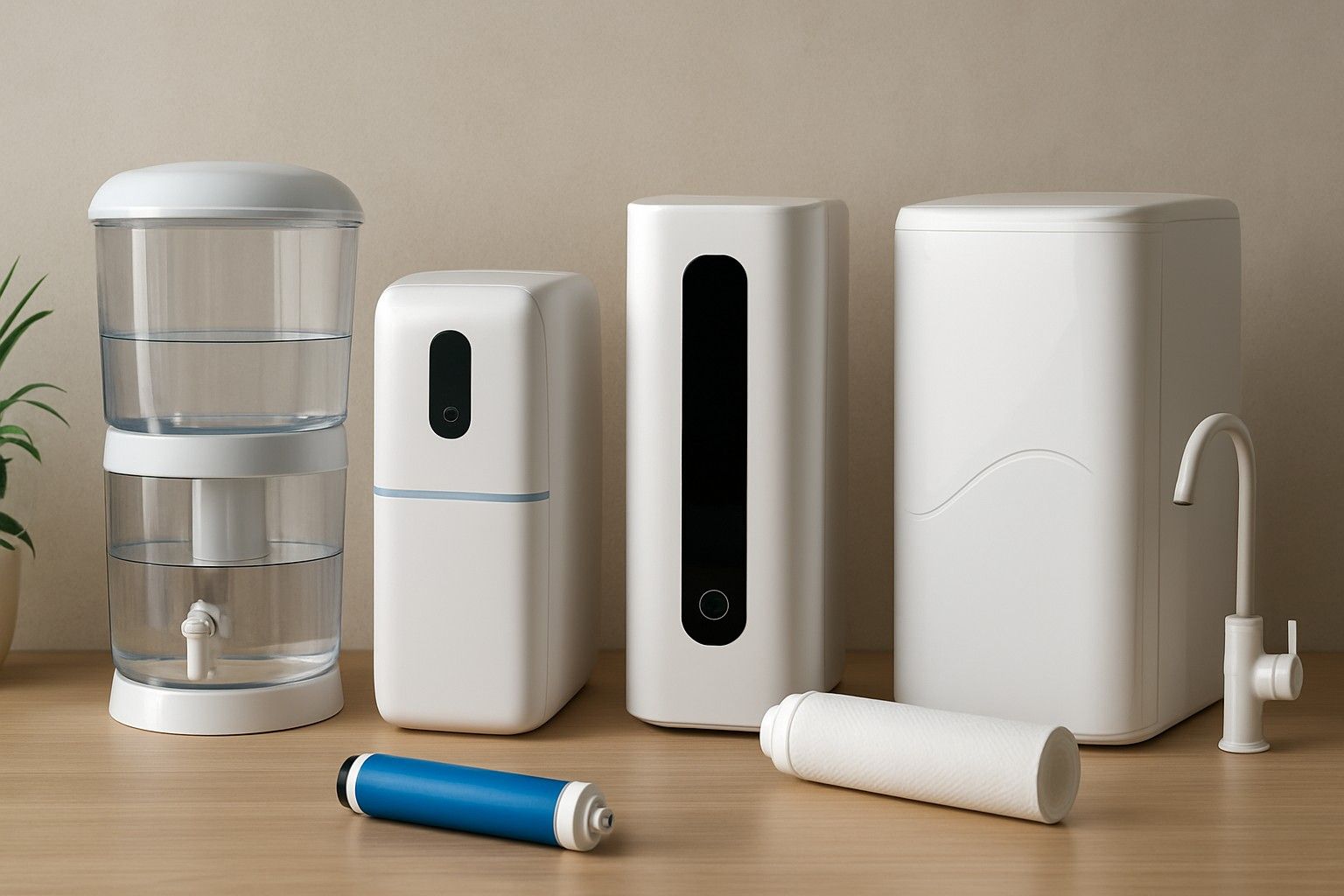
Every water purifier shopping trip in India eventually comes down to one confusing acronym soup: RO, UV, UF, and gravity. They're not interchangeable, and picking the wrong one means either paying for filtration you don't need or, worse, leaving contaminants your water actually has untreated. This article breaks down what each technology does, what it misses, and how to match one (or a combination) to your actual water supply.
How RO Purification Works and What It Removes
Reverse Osmosis works by forcing water through a semi-permeable membrane with pores fine enough to block dissolved salts, heavy metals, fluoride, arsenic and other inorganic impurities that make water "hard" or give it a metallic taste. This is the only one of these technologies that meaningfully reduces Total Dissolved Solids (TDS), which is why RO purifiers are the default recommendation wherever tap or borewell water has a high mineral or salt load — common in large parts of urban India where municipal supply or groundwater carries elevated TDS.
The trade-off is threefold. First, RO systems reject a portion of input water as waste during the membrane filtration process, so they use more water per litre purified than UV or UF systems. Second, because the membrane strips out dissolved minerals indiscriminately, most RO purifiers include a remineralization or mineral-cartridge stage afterward to add back calcium and magnesium for taste and health, and this stage matters — an RO purifier without it can produce flat-tasting, mineral-stripped water. Third, RO needs electricity to run the pump that pushes water through the membrane, so it won't work during a power cut unless the unit has a battery backup.
RO membranes also need periodic replacement as they clog with rejected solids, and this replacement cost is worth checking before you buy, since it adds to ownership cost beyond the sticker price. If your water is genuinely low in TDS, running an RO unit is unnecessary expense and unnecessary water wastage — which is exactly why the next technologies exist as alternatives, not just cheaper substitutes.
UV and UF Purification: What They Do and Don't Do
Ultraviolet (UV) purification passes water past a UV lamp that disrupts the DNA of bacteria, viruses and other microorganisms, neutralizing them without adding or removing any chemicals or minerals. It's fast, doesn't waste water, and needs very little maintenance beyond an occasional lamp replacement. But UV has one critical limitation for the Indian buying context: it does nothing to dissolved solids. If your water has high TDS, a UV-only purifier will kill the microbes in it but leave the salts, fluoride or heavy metals completely untouched — it also can't do anything about visible turbidity or suspended particles, since UV needs relatively clear water to work effectively in the first place.
Ultrafiltration (UF) uses a membrane with slightly larger pores than an RO membrane. It physically filters out bacteria, cysts and suspended particles, and unlike RO, it does this without electricity and without wasting water, making it a genuinely low-maintenance, low-running-cost option. However, UF's larger pore size means it doesn't touch dissolved salts or heavy metals either, so it shares RO's exact blind spot in reverse — good for biological safety, useless against high TDS.
In practice, neither UV nor UF alone is a complete answer for most Indian municipal or groundwater sources, which is why you'll rarely find them sold as standalone systems where TDS is a concern — they're far more commonly paired with RO as a second or third stage, covering the biological safety RO's membrane alone doesn't guarantee if there's any downstream contamination in storage tanks or pipes.
Gravity and Non-Electric Purifiers for Low-TDS Water
Gravity-based purifiers rely on candle filters or activated carbon cartridges and simple physical filtration, using no electricity and no membrane pump — water just flows downward through the filter media under its own weight. They're the simplest and cheapest category here, often sitting at the very bottom of the ₹2,999 price band, and they work well specifically where municipal water is already low in TDS and the main concern is suspended sediment, chlorine taste, or occasional microbial contamination rather than dissolved salts.
The honest limitation is that gravity purifiers can't reduce TDS or remove dissolved chemical contaminants at all, and their bacterial protection is generally weaker than a proper UV or UF stage — some rely on silver-impregnated candles for a degree of antibacterial action, which is a much lower bar than active UV disinfection. They also need manual refilling and more frequent candle cleaning or replacement since there's no pump pushing water through automatically.
Where gravity purifiers genuinely make sense is smaller towns, semi-urban areas, or households on a tight budget where the local water supply is already known to be low-TDS and reasonably clean at the source — think areas fed by treated municipal water rather than borewells. They're also a sensible backup option for power-cut-prone areas since they need no electricity to function at all. What they are not is a substitute for RO wherever water hardness or dissolved contaminants are a known issue, no matter how attractively priced they are compared to electric alternatives.
RO+UV+UF Combinations and When They Make Sense
Multi-stage purifiers that combine RO, UV and UF address the actual gap each technology leaves on its own: RO handles dissolved solids but relies on electricity and needs a mineral cartridge to avoid over-purifying the water, UV handles live microorganisms but ignores dissolved impurities, and UF adds a physical filtration backup for bacteria and cysts without extra power draw. Together, they cover dissolved contaminants, biological safety, and suspended particles in one pass, which is why combination units dominate the mid-to-upper price bands and are the most commonly recommended setup for households on municipal or borewell water with unknown or fluctuating quality.
This completeness comes at a cost, both upfront and in upkeep. A combination unit sits higher in price, typically in the ₹9,999 to ₹21,999 range depending on storage capacity and additional stages, and has more components that eventually need servicing or replacement — a membrane, a UV lamp, and one or more pre-filters, each on its own replacement cycle. Given that purifier prices in this category span ₹1,799 to ₹38,990 with an average around ₹9,499, a fully combined RO+UV+UF unit usually lands well above the entry point, reflecting the genuinely broader protection it offers rather than just added features for their own sake.
The honest question to ask before paying for all three stages is whether your water actually needs all three. If your TDS is low and your only real concern is microbial safety, a UV+UF combination without RO can do the job for less money and without wasting any water. Combination units earn their price premium specifically where dissolved solids are a confirmed problem — not as a default "safest bet" purchase regardless of your actual water source.
Matching Technology to Your Water Type
None of these technologies is objectively "better" in isolation — the right choice depends entirely on what's actually in your water, and guessing at this is the single most common mistake buyers make. High TDS water needs RO in the mix, no matter how good the UV or UF stage is, because only a membrane fine enough to block dissolved salts will bring TDS down to a palatable, safe range. Conversely, if your TDS is already low, adding RO does nothing for your health and simply wastes water and money on a mineral cartridge and membrane replacement you didn't need.
Microbial risk is a separate axis entirely from TDS. Water that tests low on TDS but comes from a source with inconsistent treatment, old pipework, or overhead tank storage can still carry bacterial contamination, which is exactly where UV or UF earns its place even in a low-TDS household. The two questions — how much is dissolved in the water, and what might be living in it — need to be answered separately before you can pick a technology with any confidence.
The only reliable way to answer both questions is to actually test your source rather than assume based on region or municipal reputation, since supply quality varies even within the same city and can change seasonally. If you haven't already, it's worth taking the time to start by checking your local water quality and TDS before comparing specific purifiers, because every recommendation in this article assumes you know that number first — without it, you're choosing a technology blind.
Choosing the Technology That Suits Your Home
Once you know your water's TDS level and have a sense of the microbial risk from your source, the technology decision mostly falls into place: high TDS points to RO or an RO combination, low TDS with microbial concern points to UV or UF, and low TDS with a clean, reliable municipal source can be handled by a gravity purifier at a fraction of the running cost. What's left after that is matching capacity, storage, and features to your household size and budget, which is a separate set of trade-offs from the purification technology itself.
Prices across this category run from ₹1,799 to ₹38,990, with the ₹2,999, ₹9,999 and ₹21,999 tiers roughly tracking gravity, UV/UF, and full RO combination units respectively — though overlap exists depending on storage capacity and brand positioning. Rather than anchoring to the lowest price in a tier, it's more useful to check where a specific model's price sits against its historical range, since that tells you whether you're paying a fair rate for the technology stack it offers, not whether you should hold out for a discount.
For the rest of the decision — capacity, installation, filter maintenance costs, and how technology choice interacts with your budget and household size — it helps to see how technology choice fits the wider buying decision, since purification technology is only the first and most consequential of several choices you'll need to make before buying.
The RO-vs-UV-vs-UF-vs-gravity question isn't really about which technology is best in the abstract — it's about what your water actually contains and what each option is built to handle. Once you've matched TDS levels and microbial risk to the right technology or combination, the rest of the purchase decision — capacity, price tier, upkeep — becomes far more straightforward than the acronyms initially suggest.

Comments
Be the first to comment.