Do You Need a Home Inverter? Understanding How They Work
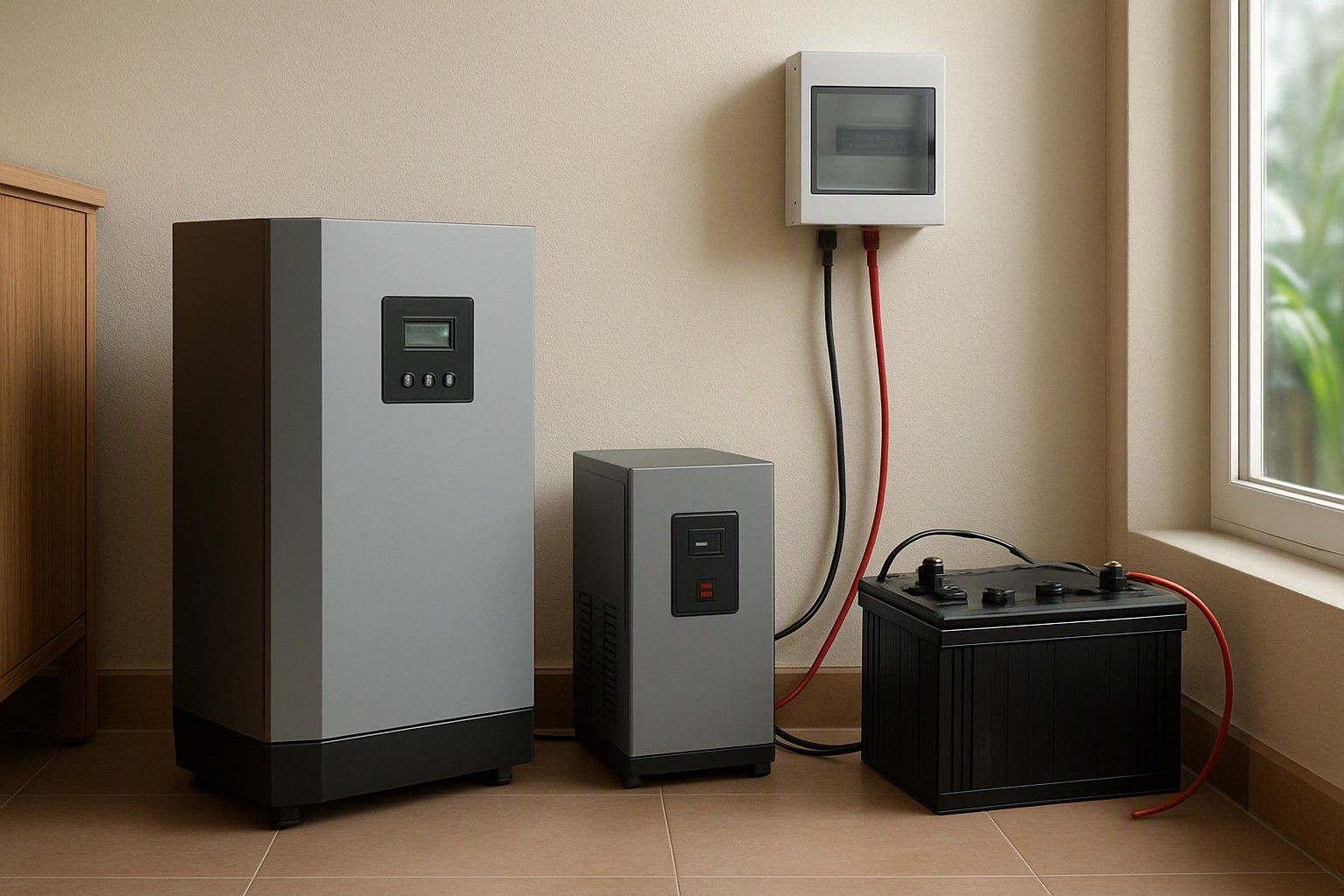
If you're wondering whether your home actually needs a backup inverter, or you've just moved somewhere with unpredictable power and want to understand what you'd be buying, this is the place to start. An inverter isn't magic — it's a fairly simple box doing one specific job, and knowing that job changes how you think about the rest of the purchase. By the end of this, you'll know exactly what an inverter does, what it can't do on its own, and whether your household has the kind of power problem it's meant to solve.
What an Inverter Does When the Grid Goes Down
An inverter's job is narrow and specific: it takes the direct current (DC) stored in a battery and converts it into the alternating current (AC) that your home's wiring and appliances actually use. The moment grid power cuts, the inverter senses the loss within a fraction of a second and switches your connected circuits over to battery power, usually fast enough that lights barely flicker and desktop computers don't restart. That's the entire function — conversion and switchover. It has no idea how long the backup will last, how many appliances you can run, or how quickly it will recharge once power returns, because none of that is the inverter's job.
This matters because a lot of confusion in the market comes from treating "inverter" as if it means the whole backup system. In reality, the inverter is the traffic controller, not the fuel tank. It decides how power flows and in what form, but it stores nothing itself. If your primary buying question is whether you need backup power at all, understanding this split is the first real filter: an inverter alone solves nothing without a battery behind it, and buying one without thinking about the other half of the system is how people end up disappointed with a purchase that looked fine on paper. The unit's rated capacity (measured in VA) tells you how much load it can switch and sustain at once, which is a separate question from how long that load will run.
The Inverter and Battery: Two Parts of One System
Once you accept that the inverter only converts and switches power, the next logical question is where the power actually comes from — and that's the battery's job entirely. The inverter's VA rating tells you the maximum load it can handle at any given moment, while the battery's capacity, measured in ampere-hours, tells you how long that load can be sustained before the system runs dry. Buy a strong inverter with a weak battery and you'll have a system that can power everything in your house for twenty minutes. Buy a modest inverter with a large battery bank and you might get hours of runtime but be unable to start a heavier appliance without tripping the unit.
This is exactly why the two components need to be sized together rather than bought as an afterthought to each other. Retailers often bundle them for this reason, but bundling doesn't guarantee the pairing suits your actual usage — a household running mostly lights and fans needs a very different battery than one trying to keep a refrigerator and a few essentials alive through longer outages. Because the battery is genuinely the half of the system that determines your real-world experience during an outage, the battery you pair it with decides your whole experience, and it's worth understanding battery types and backup duration in their own right before you finalise either purchase. Getting this pairing right upfront avoids the common regret of a system that seemed adequately priced but never matched how the home actually uses power.
Which Home Appliances an Inverter Can Realistically Run
What an inverter can run comes down to two things: the combined wattage of everything switched on at once, and whether any of those appliances draw a heavy surge of power the moment they start. Lights, fans, phone chargers, a router, and a television are light, steady loads that most home inverter systems handle comfortably, often for extended stretches depending on the battery paired with them. These are the appliances people typically buy an inverter for in the first place, and they're the ones it handles without drama.
Heavier appliances are where realistic expectations matter. A refrigerator, for instance, doesn't draw much continuously, but its compressor pulls a sharp surge of power every time it kicks in — an undersized inverter can trip or shut down at exactly that moment, even if the fridge's average consumption looks modest on paper. Air conditioners, geysers, microwaves, and induction cooktops are a different category altogether: their power draw is high enough that running them on a typical home backup setup either isn't possible or drains a battery within minutes, and most households don't size their systems for these loads at all. Motors, pumps, and mixers sit in between — manageable on a reasonably sized inverter, but worth checking against the unit's rated capacity rather than assuming. The honest way to plan is to list what you actually want running during an outage — not everything you own — and size the inverter around that real list, since chasing the ability to run everything pushes both the inverter's VA rating and the battery capacity, and therefore the price, up sharply.
Signs Your Home Genuinely Needs a Backup Inverter
Not every home needs one, and it's worth being honest about that before spending anything. The clearest sign is frequency and predictability of outages in your specific area — a locality with scheduled load-shedding or storm-prone power cuts has a very different case for backup than one where outages are rare and short. The second sign is what you stand to lose during a cut: if someone at home works from a desktop, depends on medical equipment, or if a cut during the night means no fan in peak summer, the calculus shifts quickly from convenience to necessity.
Household composition matters too. Families with young children, elderly members, or anyone managing health conditions tend to feel outages far more acutely than a household of working adults who are mostly out during the day. If your outages are brief and rare, and nothing critical depends on continuous power, a full inverter-battery system might be more than your situation calls for — a smaller UPS for a single workstation could cover the actual need. But if you've already found yourself waiting out cuts in the dark more than once a month, or rearranging plans around when the power might return, that's a genuine sign, not an exaggerated one. Systems across the market span from ₹3,500 to ₹85,000, with typical spends around ₹14,000, which is broad enough that the right question isn't whether you can afford one, but whether your outage pattern justifies the ongoing cost and maintenance of owning one.
Where an Inverter Fits Into Your Full Buying Decision
Understanding how an inverter works answers the "what is this thing" question, but it's only the first of several decisions that actually determine what you end up buying and paying. Battery chemistry, sizing the VA rating to your real load, budgeting across the ₹5,500, ₹12,000, and ₹25,000 tiers, and knowing what installation and upkeep involve are all separate questions that build on this foundation. None of them make sense to tackle until you're clear on the basic mechanics covered above, which is exactly why this is the starting point rather than the whole story.
If you've read this far and concluded that your home does have a genuine backup need, the next useful step is to map out the rest of the inverter decisions for your home, where sizing, battery choice, and budget come together into an actual purchase plan. Treat this article as the foundation and that one as the framework — trying to jump straight to comparing models without this groundwork usually means overpaying for capacity you don't need, or underbuying and being disappointed the first time the power actually goes out.
At this point, the mechanics aren't a mystery anymore: an inverter converts and switches power, the battery decides how far that power stretches, and whether you need either depends entirely on how often your power actually fails and what you stand to lose when it does. That's the honest answer to whether you need one — not a sales pitch, just a clearer picture of what the box on your wall would actually be doing for you.

Comments
Be the first to comment.