Inverter VA Capacity: How to Size It for Your Household Load
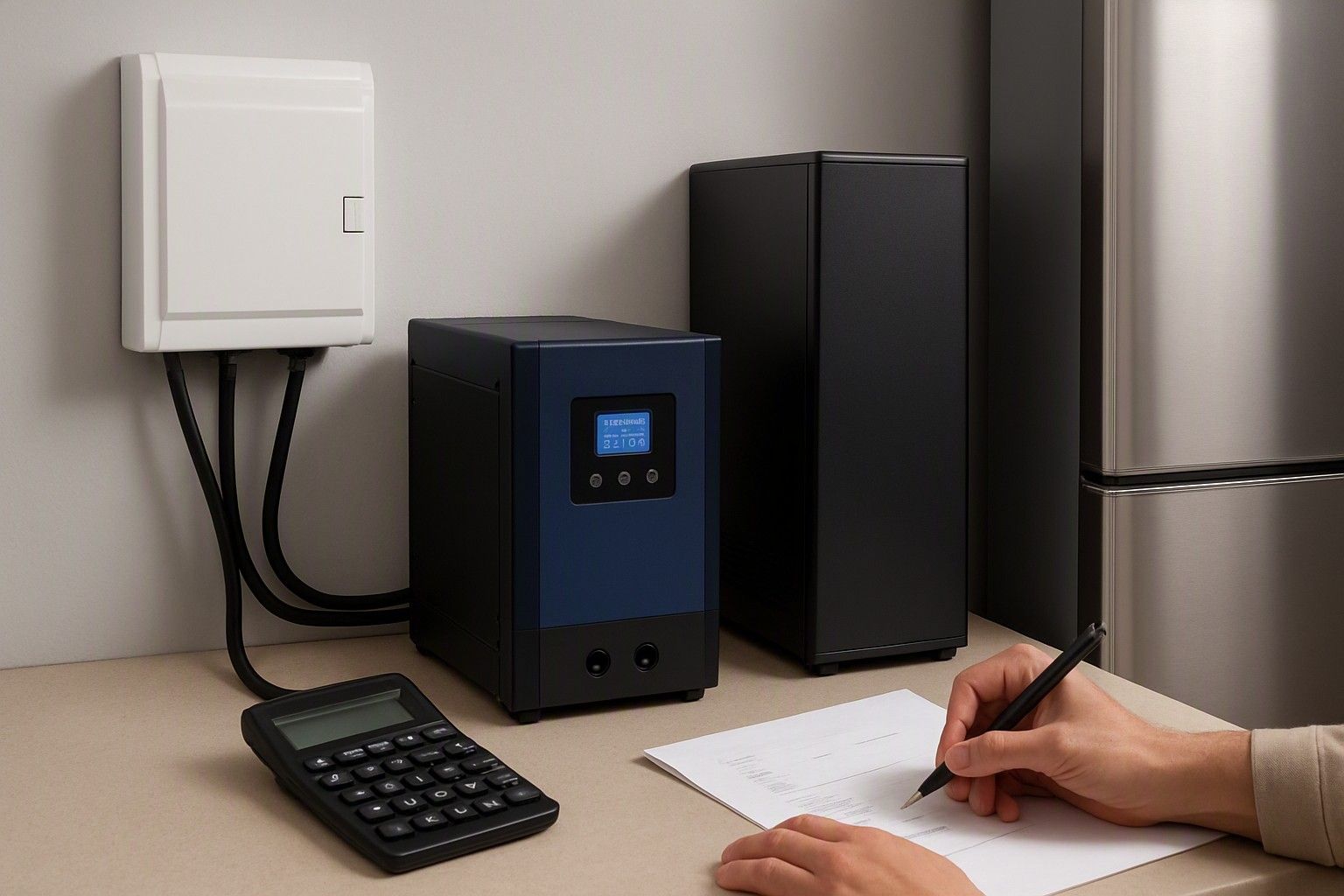
If you're staring at inverter listings wondering whether you need 900 VA or 2000 VA, the honest answer is: it depends entirely on what you plan to run, not on what the shop recommends. Getting this number wrong is the single most common mistake buyers make, leading either to an inverter that trips under load or one you overpaid for. This guide walks through the actual arithmetic so you can arrive at a VA figure that matches your household, not a generic estimate.
What VA Rating Actually Means for Your Home
VA stands for volt-amperes, and it's the figure inverter manufacturers use to describe how much apparent power the unit can supply at any given moment. It is not the same as the watts your appliances actually consume, though the two are related through something called power factor. For simple resistive loads like bulbs or heaters, watts and VA are nearly identical. But motors, compressors, and anything with a coil, think fans, mixers, refrigerators, draw extra reactive power, so their VA demand is higher than their wattage suggests, typically by a factor of 0.6 to 0.8 power factor.
This matters because if you size your inverter purely on the wattage printed on appliance labels, you will underestimate what the inverter needs to deliver. A 100-watt fan motor might actually need close to 140-160 VA from the inverter to start and run smoothly, especially during the initial surge when the motor kicks in. Inverters sold in India are rated in VA precisely because that's the number that determines whether the unit can handle your real mix of loads without tripping or overheating.
Understanding this distinction upfront saves you from two failure modes: buying based on wattage alone and ending up short, or buying blind and going oversized without knowing why. Everything else in this guide builds on getting this conversion right.
Listing Your Appliances and Adding Up the Wattage
Start with a physical walk-through of your home, not a mental guess. Write down every appliance you expect to run during a power cut, since sizing for your best-case scenario rather than your actual usage is how people end up buying twice. A typical Indian household list looks like this: ceiling fans (around 75 watts each), LED lights (10-15 watts each), a refrigerator (150-200 watts running, higher at startup), a television (80-120 watts), a laptop or charging points (65-100 watts), and if relevant, a water pump, mixer grinder, or washing machine.
Add up the wattage of everything you'd realistically want powered at once, not everything you own. Most homes don't run the washing machine and water pump during a cut, so exclude appliances you'd defer rather than run simultaneously. Be honest about this step, because it's the input every later calculation depends on. If you're unsure of an appliance's wattage, check the rating label on the back or base of the unit, most list watts or amps directly, and amps multiplied by 230 (standard Indian voltage) gives you an approximate watt figure.
Once you have your combined running wattage, keep a separate note of which appliances have motors or compressors, since those need special handling in the next step. This raw wattage total is not your VA figure yet, it's the foundation you'll convert next.
Converting Total Load Into the Right VA Rating
Take your total running wattage and divide it by 0.8, a commonly used power factor for mixed household loads, to get a baseline VA requirement. So if your appliances add up to 800 watts, you're looking at roughly 1000 VA as a starting point. This isn't a rounding trick, it reflects the real inefficiency that motor-driven appliances introduce into the system.
Next, account for startup surge. Refrigerators, water pumps, and mixer grinders draw a short burst of power, often two to three times their running wattage, when they switch on. Your inverter needs enough headroom to absorb that surge without cutting out. If your appliance list includes a fridge or pump, add a buffer rather than sizing to the exact minimum, most buyers find that rounding up to the next standard VA slab, 850, 1100, 1600, or 2000 VA, covers this surge comfortably.
Across the market, inverters span from budget models suited to a couple of fans and lights, priced from ₹3,500 in the ₹5,500 bracket, up to higher-capacity units built for fridges, pumps, and multiple rooms, priced between ₹12,000 and ₹25,000, with the overall market averaging around ₹14,000 and topping out near ₹85,000 for large home or small-commercial setups. Matching your calculated VA to the right slab, rather than picking whatever number sounds safe, is what actually determines whether the unit performs when you need it.
Why Oversizing and Undersizing Both Cost You
Undersizing is the more obvious failure. An inverter running consistently at or above its rated VA will trip on overload, shortens the life of its internal components, and leaves you without power exactly when you need it most, defeating the entire purpose of the purchase. If you've calculated a 900 VA load and buy an 850 VA unit to save money, you're not saving anything, you're buying a unit that will fail reliably.
Oversizing is less dramatic but still a real cost. A significantly larger inverter than your load requires draws more standby power, charges its (often larger, costlier) battery less efficiently at partial loads, and ties up money in capacity you'll rarely use. It's not dangerous, but it is inefficient, and the price difference between a correctly sized unit and an oversized one can be substantial once you move up VA slabs.
The VA number you choose doesn't just determine whether the inverter runs your appliances, it directly shapes how long it can run them before the battery drains, since a higher load draws down stored energy faster regardless of VA headroom. It's worth understanding how the VA you pick affects real backup hours before finalizing a number, because two households with identical VA ratings but different actual loads will get very different runtimes from the same battery. Getting VA right is only half the sizing conversation, backup duration is the other half, and the two are easy to conflate if you're comparing models on VA alone.
Load Sizing for Homes With Long, Frequent Outages
Everything above assumes fairly standard outage patterns, an hour or two, a handful of times a week. If you live somewhere with cuts that regularly stretch past three or four hours, or happen daily rather than occasionally, your sizing math needs an additional layer beyond just adding up wattage.
In these areas, the temptation is to just buy a bigger VA rating, but VA and duration are separate variables, a higher VA inverter doesn't inherently run longer, it just handles a heavier simultaneous load. What changes for long-outage households is less about VA and more about how you sequence appliance use and size battery capacity alongside VA, since running everything on your list continuously for four-plus hours draws down even a correctly sized system faster than intermittent use.
Households in these areas often benefit from deliberately trimming their must-run list further than the exercise in the earlier sections suggests, prioritizing fans, lights, and the fridge over discretionary loads, and treating VA sizing as one part of a decision that also includes battery amp-hour capacity. The calculation approach for sizing differently when cuts stretch for hours accounts for this, since a household that loses power for 20 minutes and one that loses it for six hours shouldn't necessarily land on the same specification just because their appliance list looks identical on paper.
Bringing Your Capacity Number Into the Bigger Decision
The VA figure you've now calculated is a real, usable number, but it's one input into a purchase that also involves battery type, backup duration, budget, and brand reliability. Walking into a shop or opening a listing with a specific VA target already puts you ahead of most buyers, who either guess or accept whatever the salesperson pushes.
From here, it helps to connect your load figure to the rest of the buying checklist, since VA sizing on its own won't tell you whether to choose a tubular or flat-plate battery, how much backup time to expect, or which price bracket makes sense for your usage pattern. Treat the number from this exercise as fixed and non-negotiable, don't let a lower price talk you into a smaller VA slab than your appliance list actually needs, but stay flexible on everything else, brand, battery chemistry, and exact price point, once the core sizing is settled.
You now have what most buyers skip: an actual number, built from your own appliance list, rather than a guess borrowed from a neighbor or a salesperson's default recommendation. That figure, not the price tag or the brand name on the box, is what should drive your final shortlist. Whatever inverter you eventually pick, checking its VA rating against the total you've calculated here is the one step that decides whether it does its job.

Comments
Be the first to comment.