Humidifier for a Baby's Room: Cool Mist, Placement and Hygiene Checks
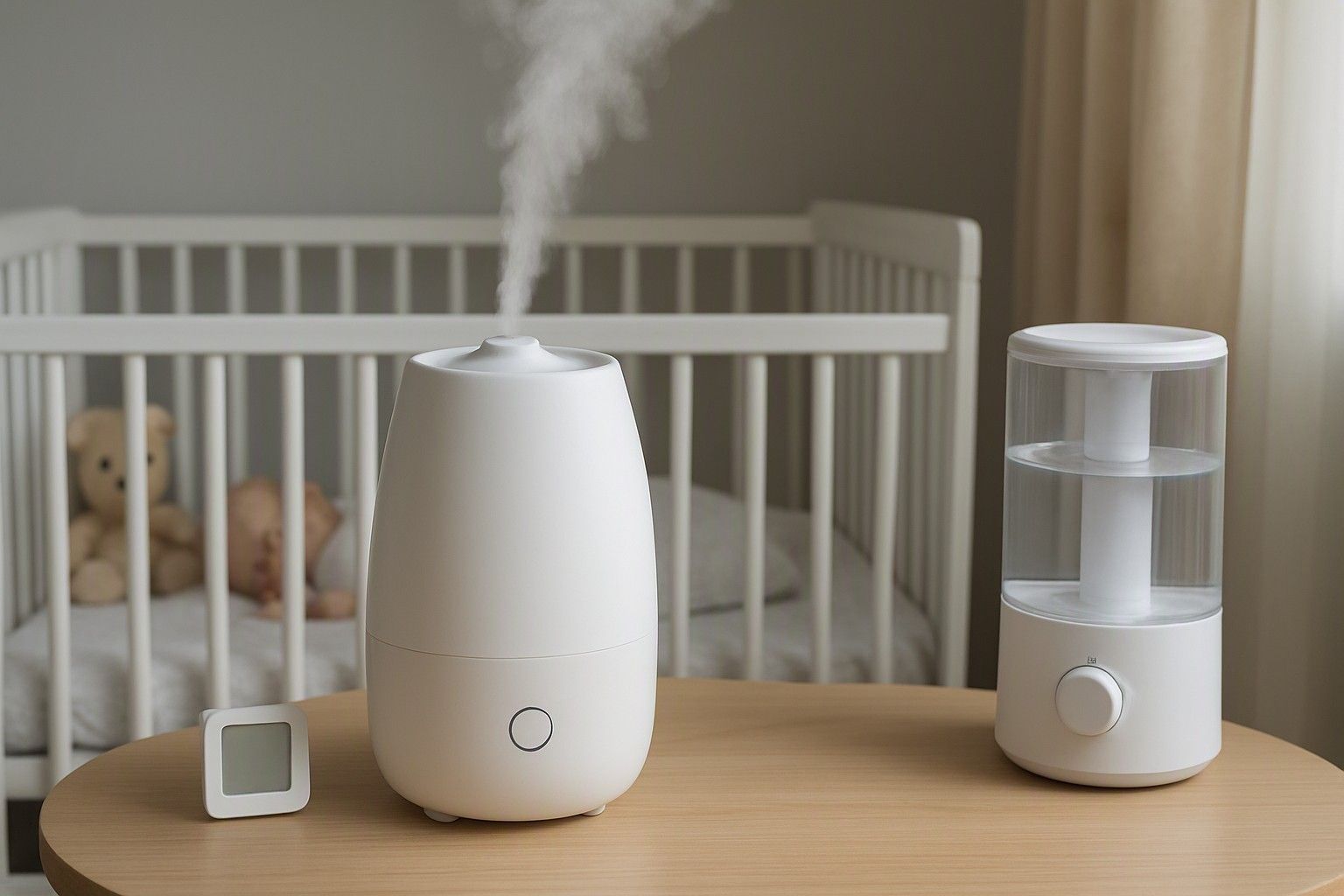
Yes, a humidifier can be safe in a newborn's room in winter, but only if you pick a cool-mist type, keep it well away from the cot and clean the tank every day. This guide is for parents comparing options before buying, and it covers type, placement, humidity targets and hygiene in the order you will need them. It does not replace your paediatrician's advice if your baby is already unwell.
Why Parents Consider One During Dry Winters
Winter air in much of north and central India is dry, and closed windows, room heaters and blowers make it drier. A newborn's nose is tiny, so dry air can leave it crusty and blocked, and a baby who cannot breathe easily through the nose often feeds badly and sleeps in short stretches. That is usually what pushes a family to look at humidifiers.
A humidifier can make a dry room more comfortable and may ease that stuffiness. It does not cure a cold, an infection or a breathing problem. If your baby has laboured breathing, a persistent cough, fever or trouble feeding, that needs a doctor, not a appliance.
It also helps to be honest about whether you need one. If you live somewhere humid, such as the coast, or your room already feels damp in winter, adding moisture can cause more problems than it solves. A cheap hygrometer will tell you the room's actual humidity within a day or two, and that reading should decide whether you buy at all.
Cool Mist vs Warm Mist Around Infants
For a baby's room, cool mist is the safer default. Warm-mist designs heat water to produce steam or a warm vapour, which brings a scald risk if the unit is knocked over, and a curious toddler or a sibling can reach a hot surface or spill hot water. Cool-mist units have no heating element, so the worst case from a tip-over is a wet floor.
Cool mist comes in two main forms. Ultrasonic models are quiet and compact, which suits a sleeping room, but they spray whatever is in the water, so hard tap water can leave fine white mineral dust on nearby surfaces. Many Indian cities have hard water, so check what water the manufacturer allows. Evaporative models pull air through a wet wick, which tends to leave less dust but needs the wick replaced and usually makes a little more fan noise.
Warm mist is sometimes preferred because heating can reduce microbes in the water, but that benefit disappears if the unit is not kept clean, and the burn risk stays. If you want the full comparison of mechanisms, noise and running costs, read the trade-offs between cool-mist and heated designs. For a nursery, the short answer is a cool-mist unit with easy-to-clean parts.
Safe Distance From the Cot and Cable Placement
Place the humidifier at least a metre or two from the cot, and aim the mist outlet away from the baby. Mist that lands directly on bedding or on your baby's face leaves everything damp, and damp bedding is not what you want on a cold night. Spread-out moisture in the room does the useful work, not a close, concentrated plume.
Put the unit on a flat, stable, water-resistant surface at about waist height or higher, such as a sturdy table or a shelf. The floor is a poor choice: mist settles on the floor, crawling babies can reach it, and a dropped or kicked unit will spill. Keep it away from curtains, wooden furniture edges and electronics, since moisture collects there.
Cable placement matters as much as distance. Use a socket close to the unit so the cable does not trail across the room, and never let it hang over the edge of a table where a baby, sibling or pet can pull it. Avoid long extension leads on the floor, and keep every plug and socket dry. Switch the unit off at the wall before refilling or moving it.
Target Humidity for a Nursery
Aim for roughly 40 to 50 percent relative humidity in the nursery, and treat 60 percent as a ceiling. Below about 30 percent, the air is dry enough to irritate the nose and skin. Above 60 percent, you invite condensation on windows, damp patches, mould and dust mites, which are a worse problem for a baby than dry air.
Do not guess. A small standalone hygrometer costs little and gives you a real number. Place it at the baby's sleeping height, away from the humidifier's outlet, because readings taken right next to the mist will be misleadingly high. A built-in humidity sensor on the unit is handy, but it reads the air around itself, so it is worth checking against a separate meter once.
Run the unit in short test sessions first and see how fast the room climbs. A closed small room can overshoot quickly, especially if you are also drying clothes indoors or have a bucket of hot water for bathing. If the reading passes 50 to 55 percent, switch the unit off or lower the output. In peak summer or monsoon, you will likely not need it running at all.
Daily Tank Hygiene to Avoid Bacterial Mist
A humidifier releases whatever is in its tank into the air your baby breathes. Water left standing for a day or two grows a film of bacteria and mould, and a dirty tank can turn the appliance from a help into a hazard. This is the main reason hygiene gets its own section in a nursery guide.
A simple daily routine covers most of the risk. Each morning, empty the tank and any water left in the base, rinse them, and wipe the surfaces with a clean cloth. Let the parts dry before refilling, then fill with fresh water each time rather than topping up old water. Never leave the unit sitting full while you are away for a few days.
Once a week, do a deeper clean to remove scale and the slippery film that forms in corners and on the mist outlet. Follow the manufacturer's manual on which cleaning agents are safe for the parts, and rinse thoroughly so no residue reaches the mist. For a fuller schedule, and to understand what wicks and filters cost over time, see a cleaning routine that keeps the tank free of slime. A tank with a wide opening that your hand fits into makes all of this far less of a chore.
Features That Matter More With a Baby in the Room
Several features that are minor extras elsewhere become real priorities in a nursery:
- Auto shut-off when the tank runs empty. A unit running dry overnight is wasted effort at best, and at worst can overheat in some designs.
- Tip-over protection. Look for a unit that stops when knocked, particularly if you have older children at home.
- A built-in humidistat or humidity display. It lets the unit hold the room near your target and stop before the air becomes too damp. Pairing it with a baby monitor that reports room temperature and humidity gives you a second reading without entering the room.
- Quiet operation, including a low or sleep mode. Fan hum or gurgling can wake a light sleeper, so check how the unit sounds on its lowest setting.
- Dimmable or switchable lights and displays. A bright indicator in a dark room can disturb sleep.
- A wide-mouth, easily removable tank. If cleaning is awkward, it will get skipped, and hygiene is the biggest safety factor.
- Capacity matched to the room. A small nursery needs far less output than a living room, and an overnight run needs a tank that lasts the night.
Safety basics matter more than which price band you end up in, since models span ₹4,500 to ₹35,000 with an average around ₹12,000. Pick the features above first, then see which tier, whether ₹5,000, ₹10,000 or ₹22,000, delivers them for your room size.
Completing Your Nursery Humidifier Choice
By now your shortlist should be clear: a cool-mist unit, sized for a small room, with a wide, easy-clean tank, auto shut-off and tip-over protection, placed a metre or two from the cot with its cable tucked out of reach. If your area has hard water, add the question of what water the unit needs and what that costs you each week.
Before you buy, cross-check capacity, water and price for a nursery model in the main buying guide. It explains how to match tank size and output to the room, how water type affects running costs, and what to expect at each price level. Since prices for this category are well established, you can decide now with a clear idea of what each tier typically offers, rather than holding off for a better moment.
Once the unit arrives, run it for a few evenings with a hygrometer before relying on it overnight. Adjust the distance and output until the room sits in the 40 to 50 percent range, and set the daily rinse as a fixed habit.
So, is a humidifier safe for your newborn's room this winter? It can be, when it is a cool-mist unit placed well away from the cot, kept to a humidity of around 40 to 50 percent, and emptied, rinsed and dried every day. Get those basics right and the type you choose matters less than how consistently you look after it. If your baby shows any breathing difficulty, check with your paediatrician before relying on any appliance.
Comments
Be the first to comment.