Hygrometer, Humidistat, Auto Shut-Off: Which Humidifier Features Are Worth Paying For
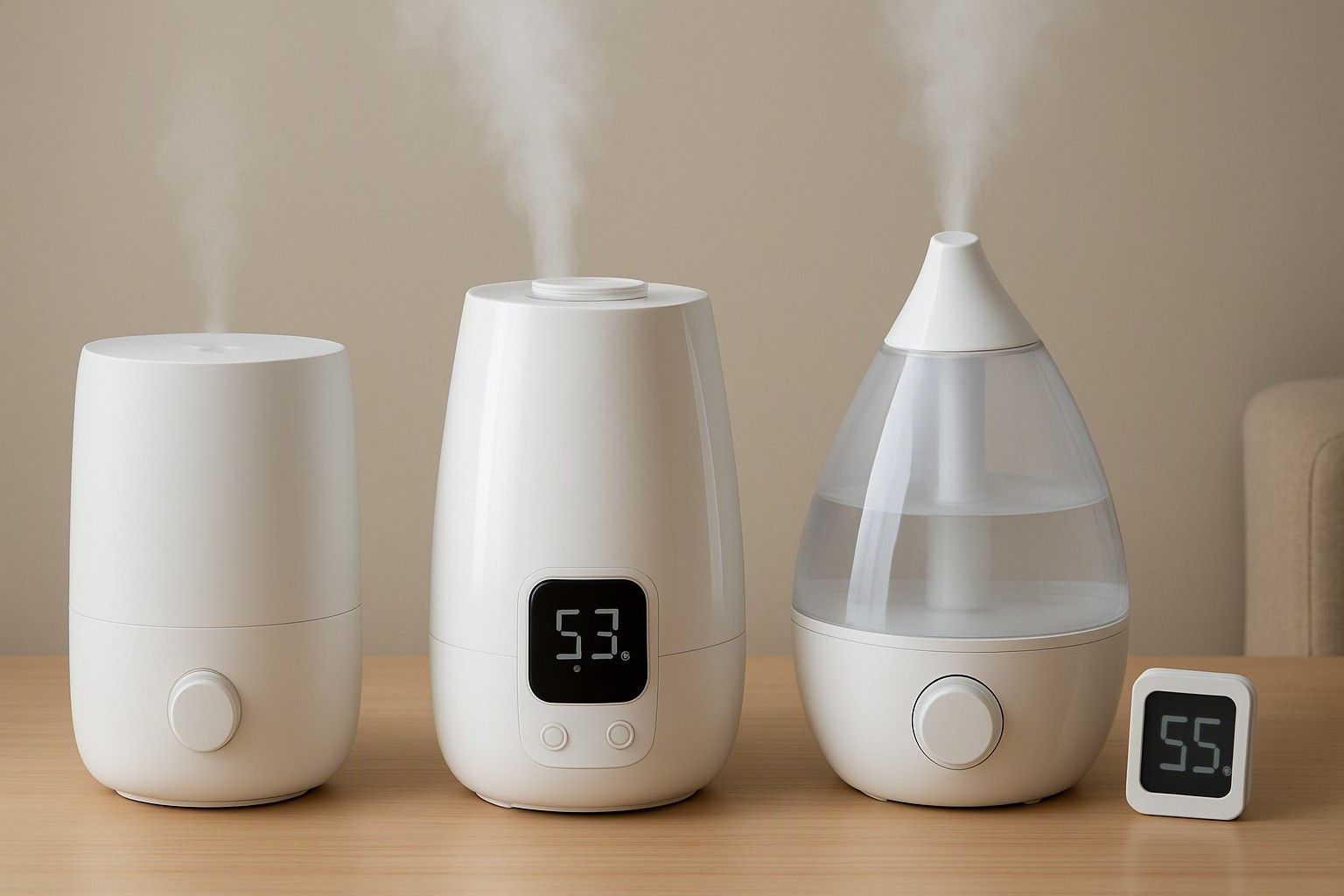
If you want a humidifier you can run overnight without checking on it, you need auto shut-off and ideally a true humidistat. If you only run one for a few hours in a room you are sitting in, a basic model with a tank-empty cut-off is usually enough. This page separates the controls that stop a room from getting too damp or a unit from damaging itself from the extras that mostly add to the price.
Built-In Hygrometer vs True Humidistat Control
These two terms are often used as if they mean the same thing, and they do not. A hygrometer only measures and displays the room's relative humidity. A humidistat uses that reading to act: it lowers the mist output or switches the unit off when the room reaches the level you set, and restarts it when the air dries out again.
This matters because over-humidifying is the real risk. In a closed bedroom, a unit that keeps misting at full output can leave condensation on windows and damp walls, which is where mould starts. A humidistat prevents this without you having to watch it. A hygrometer alone only tells you it is happening, and you still have to walk over and turn the unit down.
Be cautious with the humidity reading on cheaper models. The sensor sits close to the mist outlet, so it often reads higher than the rest of the room. Treat it as a rough guide, not a precise figure. A comfortable indoor range is generally around 40 to 60 percent.
If you do not want to pay for a humidistat, a basic model plus a separate standalone hygrometer placed across the room gives you a more honest reading, as long as you are willing to adjust the unit yourself. For overnight use in a small closed room, the built-in humidistat is the feature that earns its cost.
Auto Shut-Off When the Tank Runs Dry
Of all the features here, this is the one to treat as non-negotiable. A float or sensor detects that the tank is empty and cuts power, so the unit does not keep running with no water.
The risk depends on the type. In an ultrasonic unit, running dry can overheat and wear out the transducer, the part that creates the mist. In a warm-mist unit, a dry heating chamber can scorch the element and become a safety concern. Evaporative models are less exposed, but a wick drying out and a fan running on still wastes the unit's life.
The feature matters more in Indian homes for a practical reason. Many people fill the tank at night and expect it to last until morning, but tank capacity, room size and the output setting decide whether it does. If the tank empties at 3 am, a model with auto shut-off simply stops, and a model without it keeps running until you wake up.
It also helps during power cuts and voltage swings, because you are less likely to find a unit stuck in a bad state. Check the product description for a clear mention of tank-empty or no-water shut-off. If a listing does not mention it, assume it is missing.
Night Mode, Display Dimming and Noise Ratings
For a bedroom unit, these three features decide whether you can sleep next to it. They do not affect how well the humidifier works, but they affect whether you keep using it.
Display dimming matters more than it sounds. A bright humidity readout or indicator light in a dark room is distracting, and many buyers end up covering it with tape. A night mode that switches off or dims the lights is a cheap feature to look for.
Night mode usually also drops the output to a lower, quieter setting. This is useful, but check that it does not simply mean lights off. A true quiet setting should reduce fan or mist output too.
Noise ratings need careful reading. Manufacturers usually quote noise at the lowest setting, so the number on the box does not describe what you will hear at full output. Ultrasonic units are generally quieter, with a faint bubbling or hum. Evaporative models rely on a fan and have a steadier whoosh, which some people find soothing and others find intrusive. Warm-mist units can add gurgling as water heats.
If the unit is for a light sleeper or a child's room, prioritise a quiet low setting and a dimmable display over any app or smart feature.
Timers and Wi-Fi Apps: Useful or Gimmick?
A basic timer is useful. It lets you run the unit for a few hours before bed and have it switch itself off, which is a simple way to avoid over-humidifying when your model has no humidistat. If you have a humidistat already, a timer is a nice extra but not essential.
Wi-Fi apps are harder to justify for most households. The pitch is that you can check humidity or switch the unit on from your phone. In practice, a humidifier still needs you to be physically present to refill the tank, clean it and replace the water. Remote control does not remove any of those jobs.
There is also an Indian-specific concern. Power cuts and voltage fluctuations are common, and connected devices can drop off the network or reset their settings when power returns. Before paying for an app, find out whether the unit resumes its last setting after a cut or waits for you to restart it manually.
Apps make sense in a narrow case: a large home with a unit in a room you rarely visit, or a household that likes scheduling. For everyone else, a plain timer and a humidistat do the work of preventing over-use, and the app is the part of the price you can skip.
Aroma Trays and Why Oil in the Tank Is Risky
Some humidifiers include a small aroma tray or pad, a separate spot where a few drops of essential oil can sit so the scent spreads with the mist. This is the safer way to add fragrance, because the oil stays out of the water tank and away from the mist-making parts.
Pouring oil directly into the tank is a different matter. Many essential oils can degrade or crack certain plastics over time, leave an oily film inside the tank that is hard to clean, and coat the ultrasonic transducer so it works less effectively. A residue also gives bacteria something to grow on. Warranties often exclude damage from adding anything other than water, so this can leave you without cover.
If fragrance matters to you, look for a model with a proper aroma tray and use it sparingly. If you do not care about scent, do not pay extra for the tray. Plain water and a well-cleaned tank give you the benefit you bought the unit for.
For a closer look at the essential-oil and placement errors that shorten a unit's life, including where to put the unit and how often to clean it, that page covers the habits that matter after you buy.
Features That Add Most to the Price
Across the category, prices run from ₹4,500 to ₹35,000, with ₹12,000 as the average. Some of that spread comes from tank size and build, but features account for a large share of it.
The features that tend to push a price up the most are a true humidistat, warm-mist or hybrid operation, app and Wi-Fi connectivity, UV or other sterilising add-ons, and large-capacity tanks with higher mist output. Aroma trays and night modes add a little, but not much.
A sensible reading of the price tiers: in the ₹5,000 bracket, expect basic mist control and focus on confirming that tank-empty shut-off is there. A humidistat is more commonly found from the ₹10,000 bracket upward. App connectivity and extra add-ons tend to cluster in the ₹22,000 bracket and above, and these are the extras to question first.
The price premium is easiest to justify for the two features that protect your room and your unit: humidistat control and auto shut-off. It is hardest to justify for connectivity and sterilising claims. For a fuller picture of how much these extras push a model up the price ladder, that page breaks down what each tier typically gets you, so you can decide at today's prices rather than holding out for something better.
Ranking Features Against Your Other Priorities
Features are only one part of a buying decision. Room size, tank capacity, mist type and how easy the unit is to clean usually matter more than any control panel extra. A model with a humidistat but a tiny tank in a large room will not help you.
A practical order of priority looks like this:
- Must have: auto shut-off when the tank is empty, and a tank you can reach into and clean easily.
- Strongly consider: a humidistat if you will run the unit overnight, in a closed room, or in a child's or elderly person's room.
- Nice to have: a dimmable display, a quiet night setting and a timer.
- Skip unless you have a specific reason: Wi-Fi apps, sterilising add-ons and an aroma tray you will not use.
If you will run the unit for a few hours while you are awake and in the room, a basic model with tank-empty shut-off and a separate hygrometer will serve you well. If it will run unattended through the night, the humidistat is worth the added cost.
Once you know which of these you need, you can fit these features into an overall humidifier shortlist alongside room size, mist type and budget.
So, do you need a humidistat and auto shut-off, or is a basic model enough? Auto shut-off is the one feature to insist on in every case. A humidistat is worth paying for if the unit will run unattended in a closed room, and a basic model with a separate hygrometer is enough for short, supervised use. Apps, extra sterilising add-ons and oil-friendly tanks are the parts you can leave out, so you can choose with confidence now.
Comments
Be the first to comment.