How Big a Humidifier Does Your Room Need? Tank Capacity, Mist Rate and Runtime
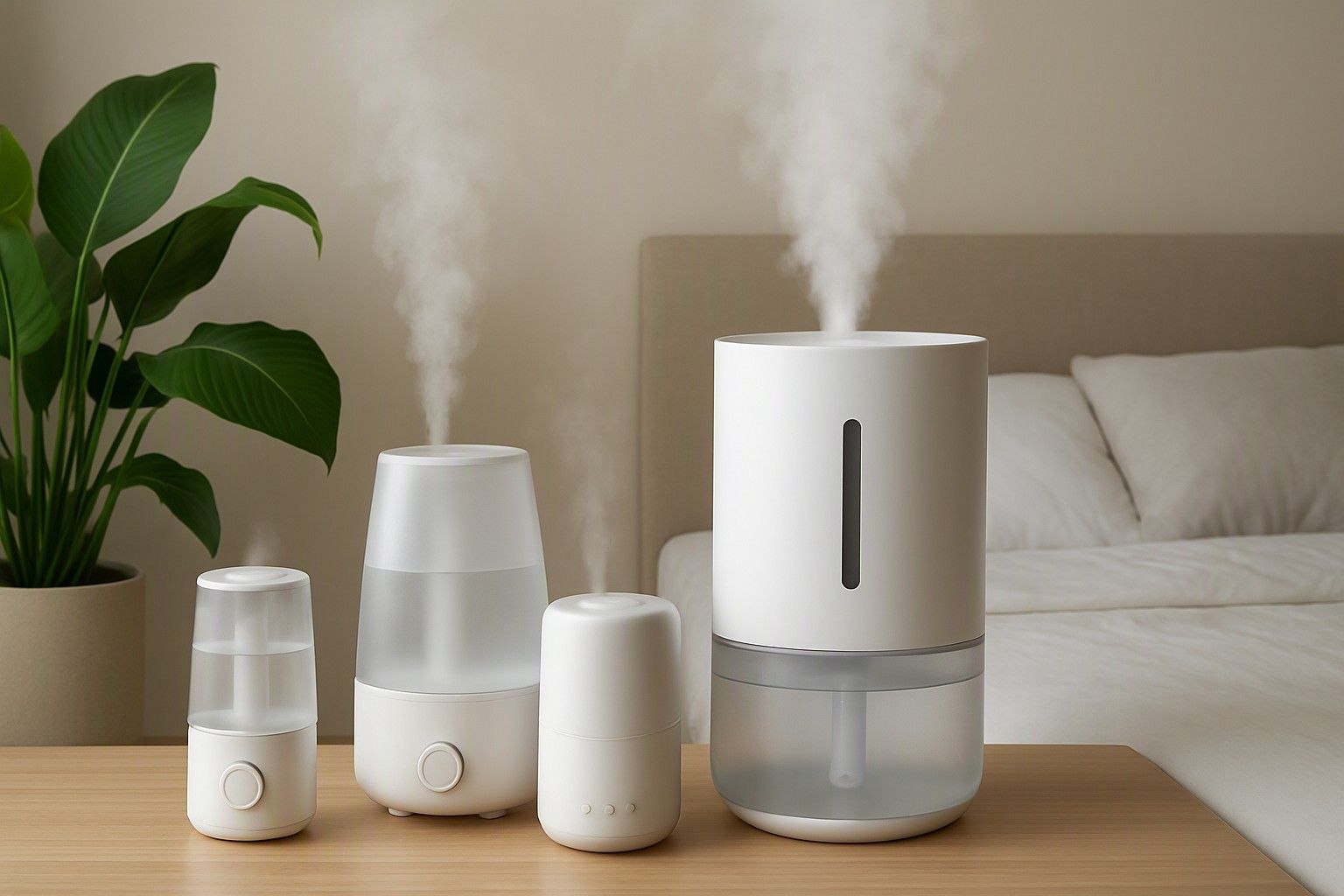
For a 120 sq ft bedroom, you need a humidifier with a modest mist output and a tank large enough to run through a full night. A larger living room or open-plan flat needs more output, and the right tank size depends on that output. This guide shows how to read the numbers on a spec sheet, so you can match them to your room and decide with confidence.
Mist Output (ml/hour) vs Rated Room Coverage
Mist output, in millilitres per hour, is the amount of water a humidifier puts into the air at its highest setting. Rated room coverage is the manufacturer's estimate of the floor area that output can handle. The two are linked, but the coverage claim is the softer number. It usually assumes a closed room, standard ceiling height and little air movement, which is not how most Indian homes behave.
Start with output and use coverage as a cross-check. As a rough working guide rather than a fixed standard, a small bedroom of up to about 150 sq ft is comfortable with a low-to-moderate output of around 200 to 300 ml/hour. Rooms of roughly 150 to 300 sq ft usually need something in the 300 to 500 ml/hour range. Beyond that, you are looking at higher-output units, or two smaller ones.
Two practical points help. First, choose a unit whose rated coverage is a little above your room's area, not far above it, because you will rarely run it flat out and it needs headroom for dry-air days. Second, check whether the quoted output is the maximum setting. A unit that gives 300 ml/hour on high may give far less on low, and that lower figure decides how long the tank lasts.
Typical Indian Room Sizes: Bedroom, Hall and Studio Flat
Most urban Indian bedrooms fall between about 100 and 150 sq ft, and a 10 by 12 ft room, which is 120 sq ft, is a very common case. Master bedrooms often reach 150 to 200 sq ft. For both, a low-to-moderate output unit with a medium tank is usually enough, as long as the door stays mostly closed overnight.
Halls and living rooms are harder to size. They commonly run from 150 to 250 sq ft and sometimes more, and they tend to be connected to a dining area, a balcony door or a passage. That openness lets humidity drift away, so size for the full connected space, not only the sofa corner. Moving up one output step from what the area alone suggests is sensible here.
Studio flats, usually a single space of 300 sq ft or more with the kitchen at one end, are different again. Cooking vapour and exhaust fans pull moisture around unevenly. In such a layout, you will often get better comfort by placing one right-sized unit near the sleeping area than by chasing whole-flat coverage with one very large machine. If you do want whole-flat coverage, two mid-sized units in separate zones give more even results and let you switch one off when you are not using that zone.
How Long a Tank Lasts Through the Night
Runtime is simple arithmetic: tank capacity in millilitres divided by the mist output in ml/hour. A 3-litre tank, which is 3,000 ml, running at 300 ml/hour lasts about 10 hours. The same tank at 500 ml/hour lasts only about 6 hours, and you wake up to a dry room and a silent machine.
Work backwards from how long you sleep. For an 8-hour night, multiply your expected output by eight. At 250 ml/hour you need roughly 2 litres, and at 400 ml/hour you need about 3.2 litres. Add a little margin, because tanks are rarely filled to the brim and nobody wants to refill at 3 a.m.
The figure that matters is the output at the setting you will actually use. Most people sleep with the machine on a medium or low setting, so the real runtime is longer than the maximum-output calculation suggests. Still, do the sum at the higher setting if your room is dry or large, since that is the case where a short tank causes problems.
An auto shut-off when the tank is empty is worth having. It stops the unit running dry and protects the mist element, so a tank that falls short of the night is an inconvenience rather than a fault.
Why High Ceilings and Cross-Ventilation Change the Maths
Coverage ratings are based on floor area, but air is measured in volume. Older Indian homes and independent floors often have ceilings of 10 to 12 ft, against the 8 to 9 ft that rating assumptions lean towards. A 150 sq ft room with a high ceiling holds noticeably more air than the same floor area with a standard ceiling, so the same unit raises humidity more slowly. If your ceilings are high, treat the room as one size larger than its floor area suggests.
Airflow matters just as much. A room with windows on opposite walls, a balcony door left ajar or a ceiling fan on high keeps replacing humid air with drier air. A fan in particular mixes the mist across the room, which is useful, but it also carries moisture out through any opening. Air-conditioned rooms behave the other way: they are sealed and dry, so a modest unit often works well there.
The practical fix is to size up one step where ventilation is strong, and to keep doors closed while the humidifier runs. If you cannot do either, a unit with adjustable output gives you room to adjust without buying twice.
When Oversizing Causes Condensation on Windows
Buying bigger is a tempting way to be safe, but an oversized humidifier in a small room has its own problems. Comfortable indoor humidity generally sits between 40 and 60 per cent. Push beyond that and the extra moisture settles on the coldest surfaces, which means window glass, outer walls and the corners behind wardrobes. In winter, when glass is cold, you will see fogged panes and wet sills within hours.
Over time this turns into the damp patches that appear when output outpaces the room, along with peeling paint, a musty smell and mould on curtains or window frames. A 120 sq ft bedroom run with a high-output unit on its top setting is a classic setup for this.
Three habits prevent it. Choose output that matches the room instead of far exceeding it. Use a unit with adjustable mist levels or a built-in humidity control, so it eases off once the room is comfortable. And keep a small hygrometer in the room, since they are inexpensive and take the guesswork out. If the reading stays above 60 per cent or the windows keep fogging, lower the setting or run the unit for shorter periods.
Top-Fill vs Bottom-Fill Tanks for Daily Refilling
If you will refill the tank every day, how it fills matters nearly as much as how big it is. A top-fill design lets you pour water straight into the unit without moving it. That is convenient with a larger tank, since you carry only a jug, not a full tank, and there is no flipping or dripping on the floor. The opening is also usually wide enough to get a hand or brush inside.
Bottom-fill tanks are lifted off the base, turned upside down, filled through a cap and screwed back on. This is workable with small tanks, but every litre of water weighs about a kilogram. A 3-litre tank is therefore a 3 kg lift to the tap and back, and a slightly loose cap leaves a wet patch on the base or the floor. The narrow neck on many such tanks also makes the inside harder to clean.
That last point links to upkeep: how tank design affects weekly scrubbing is often the deciding factor between a unit that gets cleaned and one that doesn't. As a rule, the larger the tank, the more a wide, top-fill opening is worth, because a bigger tank means a heavier daily routine.
Bringing Size Into the Bigger Decision
Once you have a target output and a tank size for your room, you have narrowed the field considerably. Size, though, is only one of the decisions. The other factors are the type of humidifier, the features you want and what you are prepared to spend and maintain, and you can balance capacity against type, features and cost in the main guide.
On price, humidifiers in this category run from ₹4,500 to ₹35,000, with an average of ₹12,000. The tiers fall into ₹5,000, ₹10,000 and ₹22,000. A unit sized correctly for one bedroom does not require the upper end of that range. Paying for much more output than the room needs buys you condensation risk, not comfort, so spend on the features that suit your routine, such as a humidity control, auto shut-off and an easy-to-clean tank. Those are the things that matter every day.
So decide with the room in front of you. Measure the floor area, note the ceiling height and the airflow, calculate the runtime you need for the night, and pick the unit that meets those numbers without overshooting them.
For a 120 sq ft bedroom, that means a low-to-moderate mist output with a tank that covers your sleeping hours at that rate. For a larger hall or studio, it means more output, an allowance for ceiling height and airflow, and often a second unit in place of one oversized machine. You now have the working to check any spec sheet against your own room.

Comments
Be the first to comment.