Hard Water and White Dust: Choosing a Humidifier for Indian Tap, Borewell and RO Water
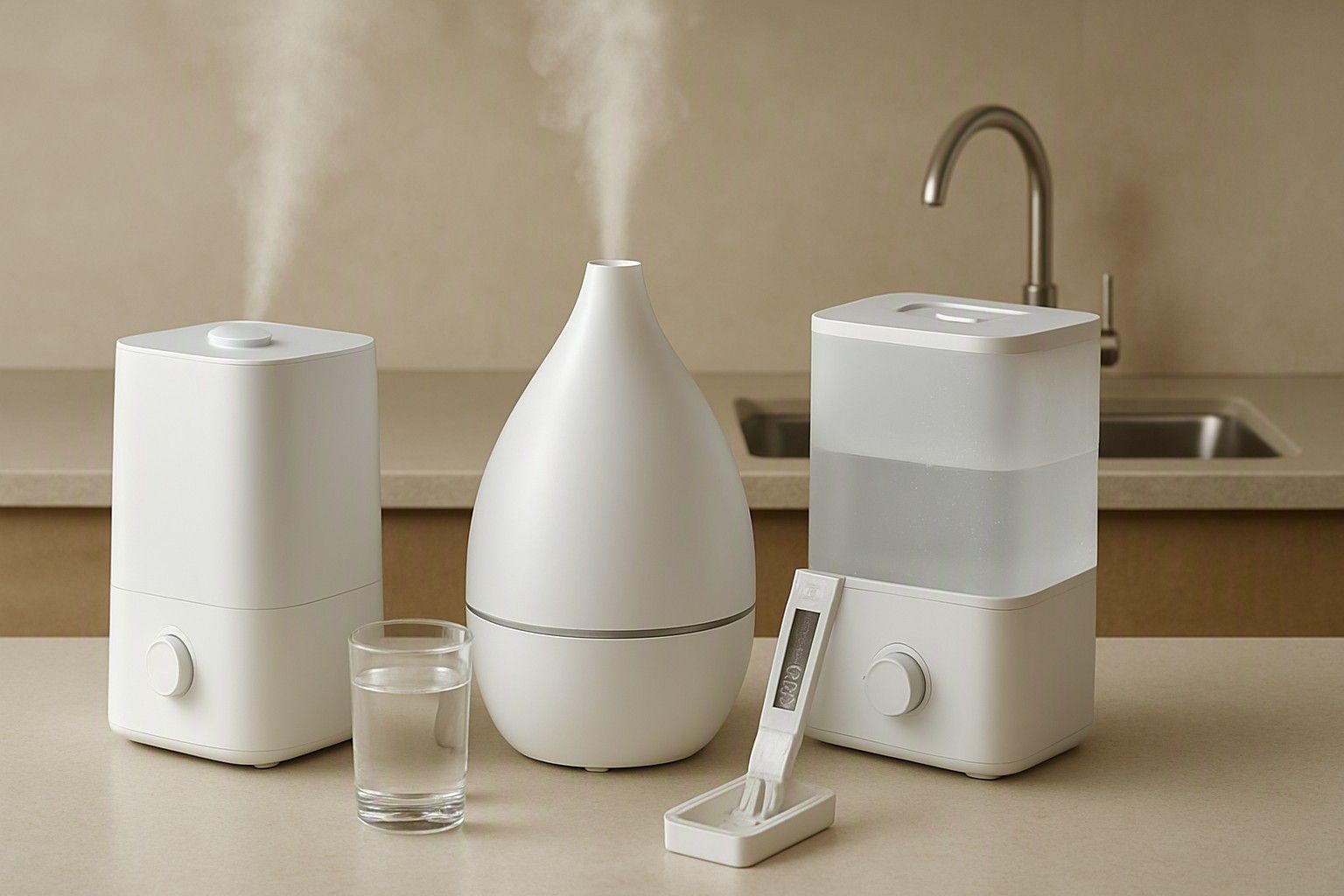
Whether you can fill a humidifier from the tap or borewell depends on two things: how many dissolved minerals your water carries, and which type of humidifier you buy. If your water leaves a white crust on the kettle or taps, this article is for you. It explains when tap or borewell water is fine, when you need RO or distilled water, and which humidifier types cope with hard water.
What White Dust Is and Why Ultrasonic Models Produce It
White dust is a fine mineral powder that settles on tables, TV stands, floors and the humidifier itself. It is mostly calcium and magnesium, the minerals that make water hard.
An ultrasonic humidifier vibrates a small plate at high frequency and breaks the water into a cool, fine mist. The machine does not separate water from minerals first. Whatever is dissolved in the tank leaves with the droplets. The water then evaporates in the room air and the minerals drop out as fine dust. The harder the water, the more dust you see.
Evaporative and warm mist designs behave differently. An evaporative unit pulls air through a wet wick, so only water vapour leaves and the minerals stay behind in the wick. A warm mist unit boils the water, and the minerals stay in the tank and heating element as scale. Neither produces the same dust, but both build up scale, which a later section covers.
The dust is a nuisance on furniture and electronics. Because the particles are very fine, they also stay airborne and get breathed in. If anyone at home has asthma or a sensitive chest, don't run an ultrasonic unit on high-TDS water.
How to Check Your Water's TDS at Home
A handheld TDS meter is the quickest way to find out what you are dealing with. It reads total dissolved solids in ppm (parts per million), and a basic pen-style meter is enough for this purpose.
Rinse a clean glass with the water you want to test, fill it, dip the probe, wait for the reading to settle and note the number. Test each source separately: the municipal tap, the borewell or overhead tank, the RO purifier's drinking water outlet, and, if you want to be sure, the RO reject water.
As a rough rule of thumb, not a manufacturer's limit:
- Below about 50 ppm: very low. Any humidifier type works, with little or no white dust.
- About 50 to 150 ppm: moderate. Ultrasonic models will leave some dust, and a cartridge can help.
- Above about 150 to 200 ppm: hard enough that an ultrasonic model on plain tap water will dust visibly.
- Several hundred ppm: common with borewells. Treat it as hard water that needs a different approach.
Borewell readings change with season and water table, so test more than once. A TDS meter measures dissolved solids, not hardness directly, but the two track each other closely enough for this decision. A white ring inside your kettle is a good visual cross-check.
Tap, Borewell, RO or Distilled: What Each Does to a Humidifier
Municipal tap water varies widely by city and even by locality. It is often moderate, which means an ultrasonic unit will dust a little and an evaporative unit will do fine.
Borewell water is where most of the trouble starts. It is frequently high in TDS and can shift through the year. In an ultrasonic humidifier it produces heavy white dust and fast scale. In an evaporative unit it clogs the wick sooner than tap water would. In a warm mist unit it coats the heating element.
RO water has most minerals removed, so it suits ultrasonic models well, but check the reading. Many household RO units mix in some raw water to keep taste, and a reading of 100 ppm or more means you will still see some dust. RO reject water is the opposite: it is more concentrated than your input water and should never go into a humidifier.
Distilled water is close to zero TDS and is the safest option for ultrasonic models. The catch is that you have to keep buying and carrying it, and a bedroom unit can empty a tank overnight.
Boiling tap water does not fix any of this. It drives off some water and leaves the minerals behind, so the dissolved solids become more concentrated, not less.
Demineralisation Cartridges and Whether They Work
Many ultrasonic humidifiers accept a small cartridge in the tank. It usually holds an ion-exchange resin that swaps out some of the calcium and magnesium as water passes through. It does help, and it is a reasonable fix for moderate tap water, since it cuts dust and slows scale.
There are three limits to keep in mind. First, the resin has a fixed capacity. The more minerals in your water, the sooner it is used up, so borewell water can exhaust a cartridge far faster than a low-TDS tap. Second, once the resin is spent it does nothing, and the change is gradual. You may only notice when dust creeps back. Third, a cartridge reduces minerals but does not remove all of them, so very hard water will still leave some residue.
The cost is ongoing, because you are buying replacements for as long as you run the machine. Before counting on a cartridge, work out how often anti-scale cartridges need replacing at your TDS level and what that adds to your running cost.
My verdict: use a cartridge to polish moderate water, not to rescue high-TDS borewell water. If your reading is well above 200 ppm, choose a different humidifier type or switch the water source.
Scale Build-Up and Its Effect on Mist Output and Lifespan
Scale is the hard, chalky deposit that builds where mineral-rich water sits or evaporates. It affects every humidifier type, though in different places.
In an ultrasonic unit, scale forms on the vibrating plate. A crusted plate vibrates less efficiently, so mist output weakens and the unit seems to be losing power. In a warm mist unit, scale coats the heating element. It then takes longer to boil the water and uses more energy, and a badly scaled element can fail. In an evaporative unit, scale stiffens the wick, which lowers how much moisture it releases into the airflow and means you replace it sooner.
Scale also leaves a rough surface that holds a slimy film more easily, so a scaled tank is harder to keep hygienic.
The practical effect on lifespan is straightforward. A humidifier kept on hard water without regular descaling will lose output first and may fail early. A routine of emptying the tank daily and descaling regularly with white vinegar or citric acid keeps most units working much longer. If your water is hard, assume that routine is part of owning the machine, and factor it into your choice.
Picking a Type That Tolerates Your Water
Match the humidifier type to your TDS reading rather than the other way round.
Low TDS (RO or distilled water): an ultrasonic model is a good fit. It is quiet, cool and efficient, and with clean water it produces little dust.
Moderate TDS (typical municipal tap): an ultrasonic unit with a demineralisation cartridge works, as does an evaporative unit. Pick ultrasonic if you want silence and are happy to replace cartridges. Pick evaporative if you want to avoid the cartridge cost.
High TDS (many borewells): this is where evaporative designs that trap minerals in the wick make the most sense. The minerals stay in the wick, nothing white gets into the air, and the main upkeep is replacing or cleaning the wick. Warm mist is the other option, because the steam leaves the minerals behind as scale in the tank and element. The trade-offs are higher power use, hot water and steam around children or pets, and descaling that cannot be skipped.
If you already own an ultrasonic unit and have only hard water, the cheapest fix is usually a change of water source, such as RO or distilled water, before replacing the machine.
Factoring Water Quality Into Your Final Choice
Treat water as the first filter in your decision. Test your TDS, note which source you will actually fill from, and then narrow to the types that suit it. Room size and budget come after that.
Prices across the category run from ₹4,500 to ₹35,000, with an average of ₹12,000. The more useful way to read that range is by total cost of ownership. A cheaper ultrasonic unit that needs distilled water or frequent cartridges every month can cost more to run than a pricier evaporative unit that tolerates your tap. Look at your price tier, whether ₹5,000, ₹10,000 or ₹22,000, and ask what each model will need from you once it is running on your water.
A short checklist before you buy:
- Your TDS reading and the water source you will use
- Whether you will commit to RO or distilled water, or need a type that tolerates tap or borewell water
- The recurring cost of cartridges or wicks at your TDS level
- Your willingness to descale on a routine
For the full picture, weigh water hardness alongside room size and price in the main buying guide. Once you know your water, you can choose with confidence today.
So, can you use tap or borewell water? Often yes, if you match the type to your TDS reading. Low-TDS RO or distilled water suits an ultrasonic model, moderate tap water works with a cartridge or an evaporative unit, and high-TDS borewell water points to evaporative or warm mist. Take a TDS reading from your own tap or tank, and you will know which category you are shopping in.
Comments
Be the first to comment.