Do You Need a Humidifier in India? Reading Your Room's Humidity First
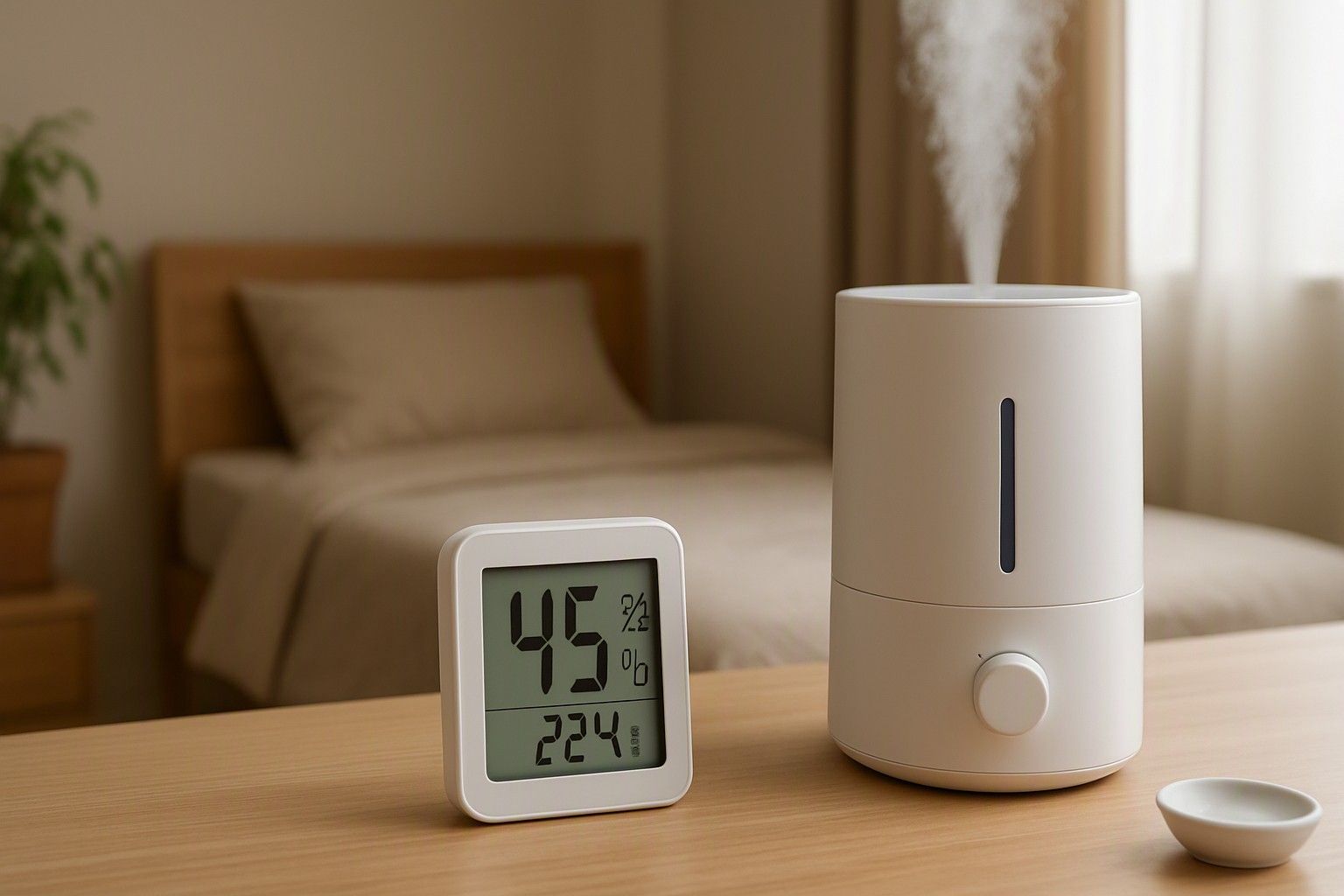
Most of India is humid for much of the year, so even a branded humidifier is not a default purchase here. You are likely to need one if you live in the northern plains or hills in winter, or if you sleep in a closed, air-conditioned bedroom for many hours every night. If you live on the coast or in the monsoon months, you probably do not. This article helps you work out which group you fall into before you spend anything.
What Indoor Humidity Level Feels Comfortable
Relative humidity (RH) is the amount of moisture in the air as a percentage of what the air can hold at that temperature. Most people feel comfortable indoors between roughly 40% and 60% RH. That is a comfort range, not a hard rule, and it shifts a little with temperature and personal sensitivity.
Below about 30%, dryness starts to show on your skin, lips and throat. Between 30% and 40% is a grey zone. Some people feel fine there, while others with sensitive skin or sinuses already notice it.
Above 60%, the problem reverses. The air feels sticky, damp patches and mould appear on walls and wardrobes, and dust mites thrive. This is the reason a humidifier can do harm in the wrong home. Adding moisture to a room that already sits at 65% makes it worse.
The question is therefore never whether humidity is good. It is whether your room's reading sits below the comfortable band for long stretches. The rest of this article helps you answer that.
Which Indian Cities and Seasons Get Genuinely Dry Air
Dry air in India is seasonal and regional, not national. The clearest case is the north: Delhi NCR, Punjab, Haryana, Rajasthan and much of Uttar Pradesh turn dry from roughly December to February. The hot, dry stretch before the monsoon, around April to June, is also dry, especially in Rajasthan and the surrounding plains. Hill regions such as Kashmir, Himachal and Uttarakhand get cold, dry indoor air in winter, made worse by heaters and blowers.
The southern and central cities fall in between. Hyderabad, Pune and Bengaluru can feel noticeably drier in the cooler months, but rarely drop as low as the north.
Mumbai, Chennai, Kolkata, Kochi and the rest of the coast stay humid almost all year. Rooms there rarely need extra moisture, except where an AC runs continuously.
Outdoor humidity is also not the same as indoor humidity. A foggy Delhi morning can read high outside while a heated, closed room is much drier. That gap is why a reading inside your own room matters more than the weather app.
Why Long AC Hours Leave Bedrooms Feeling Parched
An air conditioner cools by pulling warm air over a cold coil, and moisture condenses on that coil and drains away. The room gets cooler and also drier. In a humid city, this is often helpful, and many AC bedrooms in Mumbai or Chennai end up in a comfortable range.
The trouble starts when the room is small and sealed, the AC runs for eight to ten hours overnight, and the outdoor air is not very humid to begin with. In that case the reading can slide below 40%, and you wake up with a dry throat, tight skin or a blocked nose. Running the AC at a very low set temperature adds to this, because the unit has to pull out more moisture to get there.
Room heaters and blowers in winter work the same way, warming the air without adding any moisture.
So AC use alone is not proof you need a humidifier. It is a reason to measure. If your AC bedroom stays near 50%, you are fine. If it falls well below 40% by morning, you have found a real problem.
Symptoms That Point to Dry Air: Cracked Lips, Nosebleeds, Static Shocks
Your body and your home often give the first hints that the air is dry:
- Cracked lips and dry, itchy skin that do not improve with regular moisturiser, especially in the morning.
- A scratchy throat or blocked nose on waking, which eases after you move to another room.
- Occasional nosebleeds, caused by dried-out nasal lining.
- Static shocks from door handles, car doors, clothes or hair, which are common when RH is low.
- Dry, irritated eyes, particularly after a night in an AC room.
- Wooden furniture or doors that develop small cracks or gaps in winter.
No single symptom is proof. Dehydration, allergies, a dirty AC filter, a cold or a skin condition can cause the same complaints. A cluster of two or three that appear in the same season or only in the AC room is a stronger signal.
If nosebleeds are frequent or heavy, or breathing trouble keeps returning, see a doctor rather than assuming the air is to blame. A humidifier is a comfort measure, not a treatment.
Confirming With a Hygrometer Before You Spend
A hygrometer is a small device that reads humidity, and a basic digital one costs little compared with a humidifier. Using one for a few days can save you from buying something you will not use.
Place it at about bed or sofa height, away from the AC outlet, windows, the kitchen and the bathroom, since those spots give unusual readings. Check it at several points: late evening, first thing in the morning, and midday. Do this for three or four days, ideally during the season you are worried about.
Here is how to read the results:
- Steadily below 30%: the air is genuinely dry, and a humidifier is justified.
- 30% to 40%: borderline. Decide based on whether you have symptoms.
- 40% to 55%: your room is fine, and a humidifier will not help.
- Above 60%: do not add moisture.
Some buyers like humidifiers that come with their own humidity readout, and that feature is worth knowing about. But the reading sits right next to the unit, so it is not a good way to decide whether to buy one in the first place. Take your baseline reading with a standalone hygrometer first.
When Dry Air Comes With Smog: The North Indian Winter Question
In Delhi NCR and across the Indo-Gangetic plain, the cold months can bring dry indoor air and smog at once. Dry skin and a scratchy throat then have two possible causes, and the two machines that address them do different jobs. A humidifier adds moisture but does not remove fine particles from the air. A purifier filters particles but does not change humidity.
If your hygrometer shows low humidity and you also live where smog is a regular winter feature, you may want both, and the order matters. It helps to read up on whether purifying or humidifying should come first before deciding where to put your money.
There is also a hard-water caution. Much of north India has hard tap water, and some humidifier types can throw a fine white mineral dust into the air when fed with it. In a smoggy season, that is not what you want to add. Using demineralised or distilled water, or choosing a type that handles hard water better, avoids the problem. Either way, a humidifier is not a smog solution.
If the Answer Is Yes, What to Weigh Next
If your readings stay low and your symptoms match, buying is a sensible step. The points that matter most are the ones that fit your actual room:
- Tank size against room size. A small tank in a large bedroom runs dry or cannot raise humidity enough.
- Type of mist. Cool-mist, evaporative and warm-mist designs differ in noise, upkeep and how they cope with hard water.
- Cleaning effort. A humidifier that is hard to clean tends to grow slime and smell, which defeats the purpose.
- Night-time noise. This matters if the unit will run next to your bed.
- Auto shut-off and a humidity sensor. These stop the room from overshooting into damp territory.
On price, models in this category run from ₹4,500 to ₹35,000, with an average around ₹12,000. The entry tier (₹5,000) suits a small bedroom, the middle tier (₹10,000) usually adds capacity and better controls, and the upper tier (₹22,000) is for larger rooms and added features. Since you have confirmed the need, there is no reason to hold off. For the checks that narrow down a model suited to your home, the buying guide covers each in more detail.
You can now answer the question yourself. If your room reads steadily below 30%, or sits in the 30% to 40% range while you have symptoms, you have a case for a humidifier. If your city or season keeps the air humid, or your AC bedroom stays near 50%, you can skip it. Take the hygrometer reading first, and let that number decide.

Comments
Be the first to comment.